


Plastic vs Aluminum Tube Filling and Sealing Machines


Packaging line investments carry high operational stakes. Sealing failures, product leakage, and excessive changeover times directly erode manufacturing margins and disrupt supply chains. The physical properties of primary packaging—specifically plastic and laminates versus aluminum—alongside the specific formula fit, dictate entirely different mechanical sealing processes. A mismatch between product formulation, tube material, and machine architecture leads to severe production bottlenecks and compromised hygienic standards on the facility floor. We designed this technical evaluation framework for operations and procurement leaders to objectively compare plastic and aluminum tube filling technologies. By understanding the mechanical realities of each format, you can accurately assess hybrid capabilities, match equipment to your specific viscosity requirements, and mitigate implementation risks before finalizing equipment specifications. You will learn how to align your packaging materials with the correct sealing mechanisms to maximize line efficiency and maintain strict product integrity.
Material Dictates Mechanism: Plastic and laminate tubes require thermal or ultrasonic sealing, whereas aluminum tubes require mechanical folding and crimping.
Design Flexibility vs. Barrier Protection: Plastics offer versatile shapes (round, oval) and bounce-back properties, while aluminum provides an absolute barrier for sensitive formulas but lacks design flexibility.
Hybrid Limitations: While combination machines exist, switching between plastic and aluminum tooling introduces significant changeover downtime and mechanical complexity.
Scalability Pathways: Transitioning from semi-automatic to fully automatic systems requires evaluating throughput demands against product viscosity, fill-accuracy tolerances, and error-reduction capabilities.
Vendor Accountability: Selecting a reliable manufacturer hinges on rigorous Factory Acceptance Testing (FAT) and transparent validation protocols (IQ/OQ/PQ), especially in regulated industries.
Core Mechanics of a Commercial Tube Filling Machine
Defining the baseline success criteria for any tube filling operation requires looking past stated speeds and focusing on output quality. A high-performance tube filling machine must consistently deliver accurate fill volumes, guarantee hermetic seal integrity, maintain hygienic processing conditions, and minimize product aeration during the dosing cycle. Achieving these metrics relies on the synchronization of several core mechanical sub-systems working in tandem.
The Volumetric Dosing System
The heart of the filling process is volumetric piston injection. The piston draws product from a hopper into a cylinder on the backstroke and injects it through a nozzle into the waiting receptacle on the forward stroke. A rotary check valve directs the flow and prevents back-pressure. If the valve timing is off, the product shears or leaks, destroying fill accuracy. Matching the nozzle design to the product viscosity is non-negotiable for clean operations.
Nozzle Type | Viscosity Range (CPS) | Typical Product | Mechanical Action |
|---|---|---|---|
Shut-off Nozzle | 0 - 1,000 | Toners, Water, Serums | Internal pin drops to physically block flow and prevent dripping. |
Blow-off Nozzle | 1,000 - 50,000 | Lotions, Light Creams | A sharp blast of compressed air cuts the product string at the tip. |
Diving Nozzle | 50,000+ | Heavy Pastes, Gels | Nozzle lowers into the tube and rises with the fill level to prevent air pockets. |
Tube Orientation and Indexing Dynamics
Before any sealing occurs, the artwork must face the correct direction. The orientation station spins the tube until a photoelectric contrast sensor detects a printed registration mark (the eye mark). The machine then locks the tube in place. Reflective aluminum surfaces complicate sensor calibration compared to matte plastics, requiring advanced diffuse or retro-reflective sensors to prevent misaligned crimps. Precise servo-driven indexing ensures the seal aligns perfectly with the front and back branding.
Tube Profiles and Hygienic Standards
Mechanical adjustments allow the machine to handle diverse tube shapes. Round tubes are standard, but oval profiles require custom-machined pucks (holders) to maintain shape during indexing and sealing. Without exact-fit pucks, oval tubes deform under the pressure of the sealing jaws. Hygienic filling demands specific machine architectures. Facilities handling cosmetics or pharmaceuticals require Clean-in-Place (CIP) or Sterilize-in-Place (SIP) capabilities.
Dosing pumps, hoppers, and nozzles must feature sanitary tri-clamp connections.
Product contact surfaces must use 316L stainless steel polished to a specific Ra value.
The system must allow aggressive chemical flushing without requiring complete machine teardowns.
Seals and O-rings must be FDA-approved and resistant to high-temperature steam.
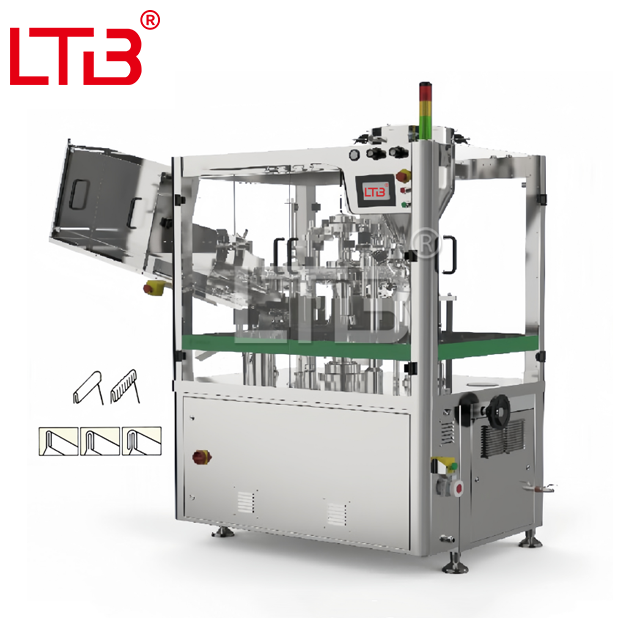
Evaluating the Plastic Tube Filling Sealing Machine
When deploying a plastic tube filling sealing machine, the primary success criteria focus on achieving a clean, aesthetically pleasing, and burst-resistant seal without degrading the product via excessive heat transfer. Plastics and laminates melt to form a bond, requiring precise temperature, pressure, and time control.
Hot Air vs. Ultrasonic Sealing Technologies
Hot air sealing is the industry standard for high-speed production. The mechanism directs precisely heated air into the inner tube wall to soften the plastic. A specialized baffle inside the hot air nozzle ensures the heat targets the inside wall while shielding the outer wall from scorching. Immediately after heating, chilled mechanical jaws clamp down to press the seal and stamp the batch code. Hot air systems offer high-speed reliability and handle standard Polyethylene (PE) and Plastic Barrier Laminate (PBL) materials effectively.
Conversely, an ultrasonic tube filler sealer utilizes friction-based acoustic tooling. A titanium acoustic horn vibrates at high frequencies (typically 20kHz or 35kHz) against an anvil, generating localized heat strictly at the seal interface. This technology excels with heat-sensitive formulations because it does not radiate heat down the tube body. It handles thicker tube walls effectively and seals through minor product contamination in the seal area.
Troubleshooting Plastic Seal Failures
Operators must monitor seal quality continuously. When a plastic seal fails, it usually points to a specific calibration error. You can diagnose the root cause by examining the physical characteristics of the rejected tube.
Blistered Outer Wall: Indicates the hot air temperature is too high or the heating dwell time is too long.
Weak or Peeling Seal: Suggests inadequate jaw pressure, insufficient heating temperature, or a worn anvil.
Leaking Corners: Points to poor jaw alignment, incorrect tube centering in the puck, or uneven cooling block temperatures.
Contaminated Weld: Caused by highly viscous product stringing from the nozzle and coating the inner sealing area before the jaws clamp.
Evaluating the Aluminum Tube Filling Sealing Machine
An aluminum tube filling sealing machine operates on entirely different mechanical principles. Aluminum cannot be welded with heat; it must be physically folded. The success criteria focus on achieving a multi-fold, airtight crimp that provides an absolute barrier against oxygen, moisture, and light.
Mechanical Crimping and Folding Mechanisms
The folding process requires a sequence of mechanical operations executed by distinct stations. The machine flattens the open end, bends it over itself multiple times, and finally crimps it flat to create a hermetic mechanical lock. The tooling requirements for aluminum are exacting. The crimping jaws must be machined to precise tolerances to prevent micro-fractures in the aluminum casing during the folding process. If the jaws apply uneven pressure, the metal tears, compromising the barrier.
Flattening Station: Smooth jaws press the open end of the cylindrical tube flat.
First Fold Station: A specialized jaw bends the flattened end 180 degrees.
Second Fold Station: Another jaw folds the metal over itself a second time.
Crimping Station: Corrugated jaws press the folds tight and stamp the batch code directly into the metal.
Fold Type | Security Level | Best Application |
|---|---|---|
Saddle Fold | Standard | Basic ointments, artist paints, standard adhesives. |
Double Fold | High | Pharmaceutical creams, topical treatments. |
Saddle & Reverse Fold | Maximum | Volatile chemicals, superglues, reactive reagents. |
Barrier Protection and Material Limitations
Aluminum remains the gold standard for volatile active ingredients, pharmaceutical ointments, superglues, reagent testing liquids, and reactive chemicals. The metal provides an impermeable barrier that prevents essential oils from leaching out and stops oxygen from degrading sensitive pharmaceutical compounds. Many aluminum filling setups integrate secondary aluminum foil sealing or utilize tubes with internal latex bands to guarantee airtight closures.
The implementation risk centers on the material's physical limitations. Aluminum lacks bounce-back. If the tube dents during the indexing, filling, or packaging process, the damage is permanent, resulting in immediate product rejection. Aluminum collapsible tubes are restricted primarily to standard cylindrical shapes, limiting design flexibility for marketing teams seeking unique shelf profiles.
Hybrid Systems and Custom Tube Filling Sealing Line Configurations
Operations handling diverse product portfolios often explore machines engineered to handle both plastic and aluminum tubes on a single chassis. While a custom tube filling sealing line offers theoretical flexibility, it requires careful evaluation of operational realities and maintenance overhead.
Engineering Compromises and Shared Components
A single base machine can share the dosing and indexing stations. The piston pump, hopper, and orientation sensors perform the same fundamental tasks regardless of the material. However, the sealing stations are fundamentally different. A hot air or ultrasonic station cannot fold metal, and mechanical crimping jaws cannot weld plastic. Hybrid machines solve this by allowing operators to physically swap the sealing modules on the main deck.
The Reality of Changeover Protocols
Swapping from plastic to aluminum is not a push-button operation. It requires skilled maintenance personnel and significant downtime. A standard changeover protocol involves multiple heavy mechanical adjustments that consume valuable production hours.
Execute the CIP protocol to purge the previous product from the dosing system.
Disconnect the pneumatic lines and remove the hot air nozzles and heating elements.
Mount the heavy mechanical folding stations and precisely align the crimping jaws using feeler gauges.
Swap all transport pucks on the indexing chain to match the new tube diameter.
Recalibrate the photoelectric sensors to read reflective metal instead of matte plastic.
Run a dry cycle at low speed to verify indexing timing and jaw clearance.
Investing in a hybrid system makes sense for contract manufacturers with long runs of diverse products where a four-hour changeover is easily absorbed into a multi-day production schedule. If your facility requires multiple material changeovers per week, purchasing two dedicated, lower-throughput machines yields higher overall equipment effectiveness (OEE) than a single hybrid unit.
Scaling Up: The Automatic Cosmetic Tube Filling Machine
Scaling from semi-automatic to fully automatic production requires evaluating throughput demands against product viscosity, fill-accuracy tolerances, and error-reduction capabilities. Upgrading to an automatic cosmetic tube filling machine fundamentally changes the labor dynamics and output potential of the packaging line.
Throughput and Sensor Integration
Semi-automatic systems require an operator to manually load empty tubes into the pucks. These units top out at 20 to 30 tubes per minute. They represent a lower capital expenditure and fit short runs or startup operations. Fully automatic systems handle the entire process without manual intervention. Empty tubes dump into a bulk hopper or load via cassettes. The machine automatically feeds, orientates, fills, seals, and ejects the finished product. High-speed indexing pushes 60 to 100+ tubes per minute.
To maintain yield at high speeds, automatic machines utilize an advanced sensor array to negate filling errors and prevent mechanical crashes.
Tube Presence Sensor: Prevents the dosing pump from firing if a puck is empty, saving bulk product and preventing messy cleanups.
Orientation Sensor: Aligns the eye mark perfectly before the tube enters the sealing station.
Fill Level Sensor: Detects air pockets or short fills immediately after the dosing station.
Ejection Sensor: Confirms the finished tube successfully left the machine and did not jam in the puck.
Downstream Packaging Integration
An automatic filler rarely operates in isolation. It must integrate seamlessly with downstream equipment to create a continuous flow. Finished tubes eject directly onto a transfer conveyor that feeds a cartoner. From there, the cartons pass over a checkweigher to verify fill volume compliance before entering a case packer. Synchronizing the PLC of the tube filler with downstream equipment via Ethernet/IP or dry contacts prevents micro-stoppages. The checkweigher can also provide feedback to the filler's servo-driven dosing pump to auto-correct fill weights on the fly, a process known as trend control.
Vendor Selection: Vetting a Tube Filling Machine Manufacturer
Separating reputable OEMs from low-tier assemblers requires strict vetting criteria. The reliability of your packaging line depends entirely on the engineering standards upheld by your chosen tube filling machine manufacturer.
Evaluating the FAT Protocol
Never accept delivery of a machine without a rigorous Factory Acceptance Testing (FAT) protocol. The FAT must involve running your actual product formulas and your actual tube stock at the vendor's facility. Testing with water or generic lotion is insufficient. You must verify that the dosing nozzles handle your specific viscosity without stringing and that the sealing jaws create burst-resistant welds.
Execute a 1-hour continuous run at the maximum rated speed to check for thermal overload or timing drift.
Perform a 10-minute simulated breakdown and recovery sequence to test the software's fault handling.
Conduct seal burst pressure testing using a vacuum chamber on random samples from the run.
Run a fill weight standard deviation analysis (CpK) to verify the volumetric accuracy of the piston pump.
Post-Sale Support and Open Architecture
Risk mitigation extends beyond the initial purchase. Watch out for the hidden costs of proprietary wear parts and locked software. Ensure the manufacturer builds the machine using standard, globally available components. Pneumatics, PLCs, and servo motors should be sourced from recognized industrial brands like Allen-Bradley, Siemens, or Festo. If a sensor fails during a night shift, you need the ability to source a replacement from a local industrial supplier rather than waiting weeks for a proprietary part to ship from overseas.
Conclusion
To move forward with your packaging line upgrade, execute the following steps:
Compile a comprehensive product matrix detailing the specific gravity, viscosity at filling temperature, and particulate size for every formula you intend to run.
Ship physical samples of your empty tubes and bulk product to the equipment vendor to conduct a formal capability study and nozzle selection test.
Draft a User Requirement Specification (URS) that explicitly defines your required throughput, acceptable reject rates, and necessary downstream PLC integration protocols.
Schedule an in-person or live-streamed Factory Acceptance Test (FAT) to verify seal integrity and dosing accuracy before authorizing the final equipment shipment.
FAQ
Q: What is the average changeover time between plastic and aluminum on a hybrid tube filling machine?
A: Swapping between plastic and aluminum tooling on a hybrid machine typically takes 2 to 4 hours. This downtime involves removing hot air or ultrasonic sealing stations, installing heavy mechanical crimping jaws, swapping tube pucks for different diameters, and recalibrating orientation sensors to read reflective metal instead of matte plastic.
Q: Can a tube filling machine handle both round and oval tubes?
A: Yes, but it requires specific size parts. Oval tubes cannot sit in standard round pucks; they require custom-machined holders to prevent deformation during indexing and sealing. Additionally, the orientation sensors and sealing jaws must be adjusted to align perfectly with the wider profile of the oval tube.
Q: Can an ultrasonic tube filler sealer handle laminated tubes?
A: Yes. Ultrasonic sealers are highly effective for both Plastic Barrier Laminate (PBL) and Aluminum Barrier Laminate (ABL) tubes. The acoustic friction generates heat directly at the seal interface. This method works well for thicker laminates and allows the machine to weld successfully even if minor product residue contaminates the seal area.
Q: What causes seal failure in a plastic tube filling sealing machine?
A: Seal failures in plastic tubes primarily stem from improper temperature settings, incorrect heating dwell times, or inadequate jaw pressure. If highly viscous product strings from the nozzle and contaminates the inner wall of the sealing area, the hot air jaws cannot form a clean, burst-resistant weld.
Q: How does an automatic cosmetic tube filling machine handle highly viscous creams?
A: To handle heavy creams and pastes, automatic machines utilize heated, agitated hoppers to improve product flow. They employ positive displacement piston pumps for forceful dosing and use specialized diving nozzles that lower into the tube and rise with the fill level, preventing trapped air pockets and product stringing.
Q: What should I look for when choosing a tube filling machine manufacturer?
A: Prioritize manufacturers that offer rigorous Factory Acceptance Testing (FAT) using your actual bulk product and tubes. Ensure they provide GMP compliance documentation (IQ/OQ/PQ) if required, guarantee local service technician availability, and build machines using non-proprietary, globally available PLC and pneumatic components.
Q: Is a custom tube filling sealing line worth the investment for a contract manufacturer (CMO)?
A: Yes. For CMOs, the investment is often justified. Despite the high initial capital expenditure and longer changeover times, a custom hybrid line provides the extreme flexibility required to bid on diverse contracts—ranging from pharmaceutical aluminum ointments to cosmetic plastic lotions—without needing to floor two separate machines.


