


What Causes Creams to Separate After Emulsification?


Cream separation hits hard on the production floor. When a 1,000-liter batch of lotion splits into oil and water, you lose raw materials, operator hours, and shipping deadlines. Formulators often blame chemical ratios or HLB mismatches. However, scaling from a lab beaker to a commercial tank exposes mechanical limits in legacy mixing setups. Emulsion instability is rarely just a chemistry error. It is a systemic failure in the bulk processing environment. Fluid dynamics, shear rates, and thermal transfer dictate whether a batch holds together or falls apart. Achieving long-term uniformity requires exact control over particle size reduction and deaeration. To stop batch failures, manufacturers must evaluate industrial-grade cosmetic formulation equipment. Upgrading your machinery guarantees the physical stability needed to meet regulatory standards and protect your profit margins.
Emulsion failure (creaming, coalescence, phase inversion) is frequently driven by inadequate shear and improper temperature control during processing, not solely incorrect HLB (Hydrophilic-Lipophilic Balance) ratios.
Failing to correctly identify and stabilize the primary emulsion type (O/W vs. W/O) leads to processing errors that cause immediate or delayed phase separation.
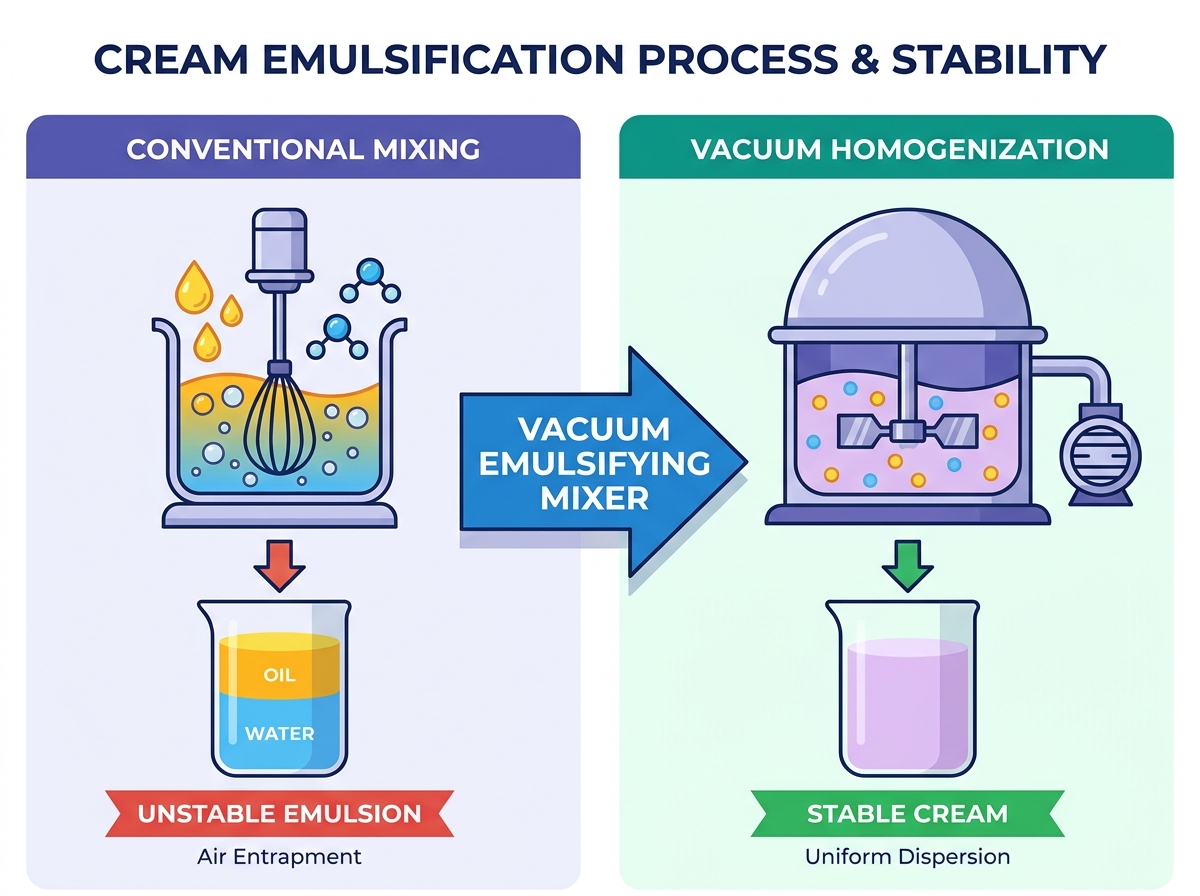
Micro-bubble entrapment during atmospheric mixing accelerates oxidation, alters specific gravity, and destabilizes the emulsion matrix, requiring vacuum intervention.
Transitioning to a Vacuum Emulsifying Mixer mitigates mechanical separation risks by combining high-shear homogenization, precise thermal regulation, and a deaerated mixing environment.
Advanced lotion production equipment enables the physical salvage and re-emulsification of separated batches, protecting profit margins from total raw material loss.
The Mechanics of Emulsion Failure: Diagnosing Instability
Coalescence and Ostwald Ripening
Emulsions naturally want to separate. The system constantly attempts to reduce its interfacial surface area. Coalescence happens when dispersed droplets collide and merge into a single, larger droplet. As this continues, the droplets grow until the oil and water phases completely divide. Ostwald ripening is a different physical mechanism. Smaller droplets dissolve into the continuous phase and redeposit onto larger droplets. Differences in solubility and internal pressure drive this transfer.
An inconsistent particle size distribution accelerates both coalescence and Ostwald ripening. When a batch contains droplet sizes ranging from 1 micron to 50 microns, physical instability spikes. This wide distribution points directly to inadequate mixing equipment. If the machinery fails to apply uniform shear across the entire tank, you get uneven droplets. Without a tight, sub-micron particle size distribution, the emulsion matrix lacks the structural integrity to hold together.
Creaming, Sedimentation, and Phase Inversion
Gravity forces separation through creaming or sedimentation. The dispersed phase migrates through the continuous phase based on density. In oil-in-water emulsions, lighter oil droplets rise to the surface. This creates a thick, concentrated layer at the top of the tank known as creaming. Sedimentation occurs when heavier particles or water droplets in a water-in-oil emulsion sink to the bottom.
Phase inversion is a total structural collapse. An oil-in-water system flips to a water-in-oil system, or vice versa. This failure happens rapidly during the cream emulsification process. Uncontrolled temperature spikes, rapid crash-cooling, or dumping phases too quickly disrupt the emulsifier film. If the mechanical energy applied does not match the thermal state of the fluid, the system inverts. You end up with a ruined batch featuring a completely altered texture and unusable viscosity.
To identify phase inversion on the floor, operators should look for these signs:
A sudden, drastic drop or spike in batch viscosity.
The product changes from a bright white cream to a translucent, greasy ointment.
The mixture refuses to absorb further water additions, causing pooling on the surface.
Electrical conductivity drops to zero (indicating water is no longer the continuous phase).
Emulsion Type Misidentification and Delayed Separation Timelines
You must verify the exact emulsion type before setting mixing parameters. Processing a water-in-oil emulsion using speeds and temperatures meant for an oil-in-water system guarantees failure. The continuous phase dictates the required shear rate, the order of ingredient addition, and the cooling curve. Misidentifying the primary emulsion type causes operators to apply incorrect mechanical force. This breaks the delicate emulsifier bonds before they fully form.
Delayed separation destroys brand reputation. Some creams look perfectly stable right after production. They pass initial quality control checks, only to separate months later in a warehouse. This delayed failure stems from microscopic weak points in the emulsion matrix. Slightly oversized droplets or localized areas of unhydrated thickener slowly degrade the structure. You must implement predictive stress testing to evaluate long-term cream stability. High-speed centrifugation, freeze-thaw cycling, and thermal aging expose these mechanical flaws before you ship the product.
Formulation vs. Processing: Isolating the Root Cause
Chemical Variables, Emulsifier Ratios, and Viscosity Modifiers
Troubleshooting separation starts with ruling out chemical errors. Incorrect oil-to-water ratios, low emulsifier concentration, or mismatched HLB values prevent an emulsion from forming. Formulators must select the right thickeners to support the system. Rheology modifiers like natural gums or synthetic carbomers stabilize the continuous phase. They build a three-dimensional network that suspends the dispersed droplets, stopping them from colliding.
If these thickeners are not properly hydrated and dispersed, they form agglomerations known as "fish eyes." Weak agitation leaves dry powder pockets inside the fluid. Without a fully developed rheological network, the continuous phase cannot support droplet suspension. Separation follows quickly. If a formula holds together during benchtop lab trials but splits on the production floor, the failure is mechanical. The chemistry works; the machinery does not.
The Impact of Shear Rate and Thermal Inconsistencies
Shear rate is the mechanical force that tears the dispersed phase into microscopic droplets. Low shear fails to reduce droplet size to the critical threshold required for permanent stability. You need droplets between 0.5 and 5 micrometers. When droplets remain too large, the surface area available for the emulsifier to bind drops. Gravity takes over, and the phases split.
Thermal inconsistencies destroy batches just as fast. Uneven heating or cooling jackets create severe temperature gradients inside the tank. Cold spots near the vessel walls cause localized crystallization of waxes and fatty alcohols. This strips them out of the emulsion matrix. Hot spots near the heating elements cause thermal degradation of heat-sensitive emulsifiers. Uniform thermal transfer is mandatory for stable emulsion formation.
Failure Symptom | Chemical Root Cause | Mechanical Root Cause |
|---|---|---|
Immediate Phase Separation | Incorrect HLB value; severe lack of emulsifier. | Insufficient shear rate; incorrect phase addition order. |
Creaming (Oil rising) | Insufficient continuous phase thickener. | Droplet size too large due to poor homogenization. |
Grainy Texture / Fish Eyes | Incompatible waxes or gums. | Poor dispersion and hydration of rheology modifiers. |
Delayed Separation | Slow degradation of preservative or emulsifier. | Micro-bubbles trapped during atmospheric mixing. |
Phase Inversion | Extreme salt concentration disrupting ionic bonds. | Uncontrolled temperature spikes or rapid crash-cooling. |
How Subpar Cosmetic Formulation Equipment Compromises Batches
The Aeration Problem in Open-Air Mixing
Standard overhead stirrers and unsealed mixing tanks pull air into the product. As the agitator spins, it creates a vortex. This vortex drags atmospheric air down into the bulk fluid. High-viscosity creams and lotions trap these air pockets instantly. The thick fluid prevents the bubbles from escaping to the surface.
Entrapped air wrecks the structural integrity of the cream. Micro-bubbles alter the specific gravity of the product, causing inaccurate fill weights on the packaging line. These bubbles disrupt the rheological networks formed by thickeners and emulsifiers. As the microscopic air bubbles slowly rise to the surface over weeks or months, they drag oil droplets with them. This accelerates creaming and phase separation. Oxygen trapped inside the matrix also accelerates the oxidation of sensitive oils, ruining the product's shelf life.
Limitations of Standalone Homogenizers
Dropping a basic homogenizing mixer into an open tank fails for high-viscosity products. Standalone homogenizers lack integrated wall-scraping agitation and vacuum capabilities. They only process the fluid immediately surrounding the mixing head. This creates massive dead zones near the vessel walls and the surface. Unhydrated thickeners and unemulsified oils sit stagnant in these dead zones.
Operators try to fix this by running the homogenizer longer. This causes over-processing. Excessive shear applied for too long physically breaks the delicate polymer networks of viscosity modifiers. The machine shears the polymer chains apart. The product experiences sudden, irreversible viscosity loss, resulting in immediate phase separation. You cannot out-mix poor tank geometry.
Evaluating a Vacuum Emulsifying Mixer for Commercial Stability
Vacuum Deaeration and Oxidation Prevention
Operating under negative pressure changes the physical dynamics of mixing. A sealed vessel pulling a deep vacuum stops air from entering the batch. This applies during both the high-shear emulsification phase and the cooling phase. As the agitator moves the product, the vacuum actively pulls existing micro-bubbles out of the fluid matrix. It deaerates the batch in real-time.
Vacuum processing directly extends shelf-life and improves product texture. Removing oxygen drops the risk of lipid oxidation and rancidity. The absence of air pockets ensures a dense, uniform cream with a smooth, glossy appearance. Preventing air-induced separation guarantees that the emulsion matrix remains tightly packed and structurally sound from the tank to the jar.
Integrated High-Shear Homogenization
The core of a Vacuum Emulsifying Mixer is its rotor-stator homogenization assembly. This mechanism features a rapidly spinning rotor housed inside a stationary stator. As the fluid enters the workhead, centrifugal force drives it through the narrow gap between the rotor and stator.
This action hits the dispersed phase with extreme mechanical shear, hydraulic shear, and cavitation. Bottom-entry homogenizers handle heavy creams, while top-entry homogenizers work well for lighter lotions. Both deliver uniform, sub-micron particle size reduction. This intense energy creates a tightly bound, highly stable emulsion matrix. The droplets become too small and too evenly distributed to undergo coalescence or Ostwald ripening.
Precision Thermal Regulation, Phase Addition Control, and Sweep Agitation
High-end mixing vessels use complex counter-rotating agitators equipped with Teflon scrapers. These scrapers physically contact the inner walls of the vessel. They continuously sweep the boundary layer of fluid. This stops product burn-on during heating and prevents localized crystallization during cooling. You get perfectly even heat transfer throughout the entire batch volume.
Precise temperature control stops the premature solidification of the oil phase before it emulsifies. Vacuum mixers also allow for automated, sub-surface phase introduction. Instead of dumping the oil phase onto the surface of the water phase, operators use the vacuum to pull the secondary phase directly into the high-shear zone of the homogenizer head. This ensures immediate, controlled dispersion. It prevents the pooling of raw materials and drastically reduces the risk of phase inversion.
Upgrading Your Lotion Production Equipment: Decision & Salvage Framework
Salvage and Recovery: Re-Emulsifying Separated Batches
When a batch separates, do not throw it away immediately. Advanced lotion production equipment gives you the mechanical power to salvage and re-emulsify failed batches. The recovery protocol requires carefully re-introducing the separated material back into the main vessel.
First, raise the temperature slowly with continuous sweep agitation. This melts crystalline structures and lowers the viscosity of the separated phases. Once you hit the target temperature, engage the high-shear homogenizer to forcefully re-disperse the oil and water. If the failure stems from a slight chemical deficiency, use the vacuum system to draw in corrective slip-streams of additional emulsifier or pre-hydrated thickener directly into the shear zone. This targeted mechanical and thermal intervention stabilizes the matrix and saves the batch.
Bench-to-Production Scalability Criteria
Transferring a formula from the lab to the production floor requires strict scalability criteria. You cannot just multiply ingredient weights. You must match mechanical forces. The primary metric is maintaining equivalent shear rates and rotor tip speeds between the benchtop homogenizer and the commercial unit.
Geometric similarity matters just as much. The aspect ratio of the lab beaker must loosely mirror the dimensions of the production vessel. This ensures similar macro-flow patterns. You must also calculate heat-exchange dynamics. A 1-liter lab batch cools much faster than a 1,000-liter production batch. Understanding how this extended cooling curve affects wax crystallization dictates the required agitation speeds during scale-up.
Implementation Risks and Mitigation Strategies
Moving to automated vacuum systems introduces a learning curve for floor operators used to manual open-tank mixing. Programmable Logic Controllers (PLCs) require precise parameter input for vacuum levels, rotor speeds, and temperature ramps. You must provide comprehensive operator training to prevent input errors that ruin large-scale batches.
Complex rotor-stator heads and vacuum lines present cleaning challenges. You must establish rigorous Clean-in-Place (CIP) and Sterilize-in-Place (SIP) validation protocols. Residual product left in the homogenizer gap or transfer piping introduces microbial contamination or incompatible chemical residues into the next batch. Cross-contamination acts as a physical catalyst for emulsion failure. It rapidly breaks down the preservative system and destabilizes the emulsion matrix.
Conclusion
Formulation chemistry provides the foundation for any cosmetic product, but mechanical processing dictates its commercial viability. Unresolved separation issues at scale point to equipment deficiencies, not fundamental formula errors. Relying on outdated mixing technology guarantees inconsistent particle sizes, entrapped air, and thermal gradients. These factors lead directly to batch failure.
When evaluating infrastructure upgrades, prioritize equipment that offers verifiable particle size reduction, integrated vacuum capabilities, continuous sweep agitation, and precise thermal control. Cheaper, single-function mixers cannot provide the multi-dimensional processing environment required for modern, complex emulsions.
Take these next steps to protect your production margins:
Audit your current batch failure rates to identify specific patterns in separation and phase inversion.
Run diagnostic stability testing, including high-speed centrifugation, on borderline batches to expose hidden mechanical weaknesses.
Standardize your scale-up protocols by matching rotor tip speeds and shear rates between lab and production equipment.
Schedule a trial run with a vacuum-rated mixing system to physically observe the difference in emulsion density and long-term stability.
FAQ
Q: Why does my cream look stable initially but separate after a few weeks?
A: Delayed separation is usually caused by micro-bubbles trapped during atmospheric mixing or a wide particle size distribution. Over time, the bubbles rise, and uneven droplets merge through coalescence. This eventually breaks the emulsion matrix. Vacuum processing eliminates this issue by removing air during emulsification.
Q: Can I fix a cream batch that has already separated?
A: Yes, if you have the right equipment. You must reheat the batch to melt the phases, apply high-shear homogenization to re-disperse the droplets, and use vacuum to pull in a small amount of corrective emulsifier to restabilize the mixture.
Q: What is the difference between creaming and phase inversion?
A: Creaming is a gravity-driven separation where oil droplets rise to the top, but the emulsion type remains intact. Phase inversion is a total structural collapse where an oil-in-water emulsion flips to a water-in-oil emulsion, usually caused by severe temperature shocks or incorrect phase addition.
Q: Why is vacuum necessary for high-viscosity lotions?
A: High-viscosity products trap air easily during mixing. Vacuum removes this air, preventing oxidation, ensuring accurate fill weights, and stopping micro-bubbles from physically disrupting the rheological network that holds the emulsion together.
Q: How do I know if my homogenizer is causing the separation?
A: If your homogenizer lacks sweep agitation, it creates dead zones where thickeners remain unhydrated. Running a standalone homogenizer for too long can also over-process the batch, physically shearing and destroying the polymer chains of your viscosity modifiers.
Q: What role does temperature play in emulsion stability?
A: Temperature controls the viscosity of the phases and the solubility of emulsifiers. Uneven heating causes localized crystallization of waxes, while rapid cooling can shock the system into phase inversion. Precise thermal regulation is mandatory for stable emulsions.


