


50L vs 500L Vacuum Emulsifier: Which Batch Size Fits Your Factory?


Scaling production from pilot validation to full-scale manufacturing introduces severe equipment sizing challenges. Transitioning from benchtop formulations to industrial batch processing requires precise calculations regarding thermal dynamics, shear rates, and facility infrastructure. Selecting the incorrect batch size leads to immediate operational inefficiencies on the factory floor. Undersizing creates production bottlenecks and excessive labor costs. Oversizing results in wasted capital expenditure, excessive facility footprint, and product spoilage due to minimum fill-line limitations. Formulators often find that recipes behaving perfectly at the 5L scale fail completely when subjected to the thermal lag and altered fluid dynamics of a massive vessel. A systematic, technical evaluation of 50L and 500L systems is required to align equipment specifications with throughput requirements, facility constraints, regulatory certifications, and product lifecycle stages. Understanding the exact mechanical and logistical differences between these capacities ensures seamless scale-up and prevents costly manufacturing disruptions.
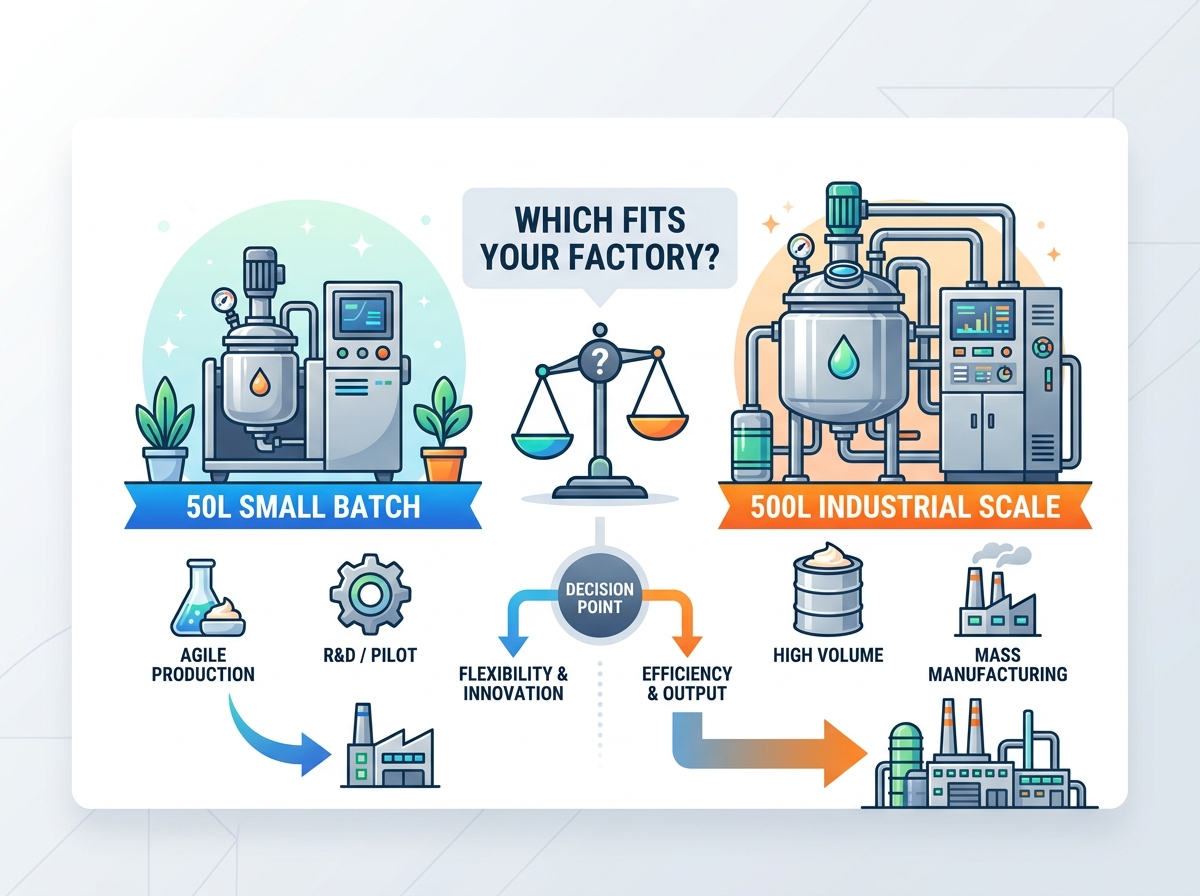
A 50L vacuum emulsifier is engineered for pilot testing, R&D validation, clinical trial batches, and high-mix/low-volume agile manufacturing.
A 500L vacuum emulsifier serves stable, high-volume commercial production but demands significant facility infrastructure, utility upgrades, and automation.
Evaluating vacuum emulsifier capacity requires analyzing cycle times, thermal dynamics, actual working volume ranges (minimum vs. maximum fills), and Clean-in-Place (CIP) protocols, not just raw vessel volume.
Scaling from 50L to 500L involves non-linear changes in shear rates, heating/cooling times, and material handling logistics, often requiring the integration of inline recirculation loops to maintain emulsion stability.
Defining the Baseline: What Dictates Equipment Sizing?
Establishing the correct equipment size for a specific manufacturing facility requires looking beyond the raw liter designation on the specification sheet. The true capability of a Vacuum Emulsifier is dictated by the intersection of product formulation, facility constraints, and shift schedules. Plant managers must evaluate actual throughput rather than static holding volume.
Production Volume vs. Product Mix
A high-mix, low-volume strategy favors smaller, agile units. Facilities producing dozens of different SKUs per week require equipment that operators can clean and change over rapidly. Contract manufacturers handling niche cosmetic lines or specialized pharmaceutical ointments rely on this flexibility. Conversely, a low-mix, high-volume strategy necessitates larger vessels. When a factory dedicates entire shifts to a single product, such as a mass-market body lotion or commercial mayonnaise, maximizing the volume per batch becomes the primary driver of efficiency.
Production Strategy | Ideal Equipment Size | Changeover Frequency | Primary Advantage |
|---|---|---|---|
High-Mix / Low-Volume | 50L - 100L | Multiple times per shift | Agility and rapid SKU switching |
Low-Mix / High-Volume | 500L+ | Once per week or less | Maximum throughput per labor hour |
R&D / Clinical Trials | 10L - 50L | After every batch | Precise parameter control and validation |
Cycle Time and Throughput Realities
Raw vessel volume does not equal daily throughput. True throughput is calculated by multiplying the actual batch volume by the number of completed cycles per shift. This calculation must factor in loading raw materials, the heating and mixing phases, discharging the highly viscous finished product, and the mandatory cleaning protocols. A smaller machine might complete four cycles in an eight-hour shift. A larger machine might only complete two due to extended heating and cleaning times.
Calculate total raw material loading time, including powder induction and liquid phase transfer.
Determine the heating ramp rate based on available utility utilities (steam vs. electric).
Measure the required homogenization and holding time for the specific formulation.
Factor in the cooling phase, which often takes longer than heating in large vessels.
Add the discharge time, accounting for pump flow rates and fluid viscosity.
Include the full CIP/SIP cycle time required before the next batch can begin.
Regulatory & Certification Baselines
Industry-specific standards heavily impact design choices at both scales. FDA, GMP, ISO, and CE compliance dictate the materials of construction and sanitary design. Contact parts must utilize 316L stainless steel to prevent corrosion and product contamination. The external jacket and cladding typically use 304 stainless steel. These regulatory baselines mandate specific surface finishes, dead-leg-free valve designs, and verifiable cleaning protocols regardless of whether the vessel holds 50 liters or 500 liters. Evaluating vacuum emulsifier capacity means ensuring the chosen size can meet these strict sanitary requirements without causing production delays.
The 50L System: Pilot Scale and Agile Manufacturing
Bridging the gap between laboratory formulation and commercial production requires specialized equipment. The 50L system serves as the validation step before committing to massive capital expenditures.
Solution Category Definition
A 50L unit distinguishes itself from benchtop laboratory mixers by incorporating industrial-grade components. It features true rotor-stator homogenizers, scraped-surface agitation, and jacketed heating/cooling systems that mirror full-scale production units. This allows engineers to accurately model the shear rates and thermal transfer profiles that the product will experience during mass manufacturing. Benchtop units simply cannot replicate the mechanical forces present in a factory environment.
True Batch & Working Volume Limits
The operational range of a 50L vacuum emulsifier is typically a working volume of 15L to 40L. Operating below 15L risks exposing the homogenizer head. This leads to severe aeration, foaming, and mechanical damage to the seals. Operating above 40L risks pulling product into the vacuum lines during vigorous boiling or mixing phases, which ruins the vacuum pump and contaminates the utility lines.
Core Capabilities and Ideal Use Cases
This capacity excels in specific manufacturing scenarios where precision and flexibility outweigh raw output volume.
Cosmetic formulation of premium creams, serums, and lotions where raw ingredient costs are exceptionally high and waste must be minimized.
Pilot-scale pharmaceutical batches, including medicated ointments and transdermal gels requiring strict batch records.
Food-grade specialty items requiring precise temperature control and homogenization.
Scale-up validation runs to finalize standard operating procedures (SOPs) before full-scale deployment.
Facility and Utility Footprint
The minimal infrastructure requirements for a small batch vacuum mixer make it highly versatile for smaller plants or dedicated R&D labs. These units generally require standard electrical connections, often running on single-phase or light three-phase power. They frequently utilize localized, self-contained electrical heating elements and compact chilling units. This eliminates the need for massive factory boilers or centralized cooling towers, drastically reducing installation costs and facility modifications.
Limitations
Despite its agility, the 50L system cannot meet mass-market demand. It lacks the automation scaling necessary for continuous, high-volume output. Relying on multiple small batches to fulfill large orders results in significantly higher per-unit labor costs. It also increases the risk of batch-to-batch inconsistency, as operators must manually weigh and load ingredients more frequently.
The 500L System: Full-Scale Industrial Production
Transitioning to half-ton batch processing shifts the focus from formulation validation to maximum throughput, mechanical reliability, and utility management.
Solution Category Definition
Engineering requirements for a 500L system are vastly different from pilot units. These machines require heavy-duty structural frames, high-torque gearboxes, and sophisticated hydraulic systems to lift the massive vessel lids. They are designed for continuous, rigorous operation in demanding industrial environments where downtime costs thousands of dollars per hour.
True Batch & Working Volume Limits
The operational parameters of a 500L vacuum emulsifier typically dictate a working volume of 150L to 400L. Processing below the 150L minimum threshold fails completely. The temperature probes and homogenizer heads are not fully submerged. This results in localized burning against the jacket, inaccurate temperature readings, and catastrophic emulsion failure. Operators cannot simply run a small test batch in a machine of this size.
Batch vs. Inline Integration Options
To bypass standard cycle-time bottlenecks and ensure ultra-fine droplet size, a 500L batch vessel is frequently integrated with an inline emulsifying machine or an external recirculation loop. This setup pulls product from the bottom of the tank, forces it through a high-shear rotor-stator workhead outside the main vessel, and pumps it back to the top. This drastically reduces mixing times for large volumes and guarantees uniform particle size distribution without overworking the internal agitators.
Core Capabilities and Ideal Use Cases
Large-scale systems are deployed for operations requiring massive, consistent output.
Stable market demand fulfillment for established product lines.
Mass-market FMCG cosmetics, including shampoos, conditioners, and body washes.
Large-scale food processing, including sauces, condiments, dressings, and jams.
Bulk chemical manufacturing requiring stable emulsions and precise temperature control.
Infrastructure and Utility Demands
The heavy industrial requirements for a 500L unit are substantial. Facilities must ensure adequate floor load-bearing capacities to support the machine's weight plus half a ton of dynamic fluid load. These systems demand dedicated three-phase power drops. They require industrial steam generators or boilers for rapid heating. High-capacity chilled water loops are mandatory to cool the massive thermal mass efficiently. Attempting to run a 500L vessel on electrical heating elements results in unacceptably long cycle times.
Operational Complexities at Scale
Manual operation is no longer viable at this scale. Success requires automated ingredient dosing systems. Load cell integration is necessary for precise weight measurement directly in the tank. Integrated discharge and transfer pumps are required to move high-viscosity fluids. Mechanized lid-lifting systems are mandatory for maintenance and cleaning access, as operators cannot manually lift the heavy stainless steel covers.
Head-to-Head Evaluation: 50L vs. 500L Systems
Comparing the two capacities across critical technical performance metrics reveals distinct engineering realities that plant managers must address during the procurement phase.
Evaluation Metric | 50L Pilot System | 500L Industrial System |
|---|---|---|
Working Volume Range | 15L - 40L | 150L - 400L |
Heating/Cooling Speed | Rapid (High surface-area-to-volume ratio) | Slower (Requires high-capacity steam/chilled water) |
Cleaning Protocol | Manual or Semi-manual | Automated CIP/SIP mandatory |
Material Handling | Manual pouring/loading | Automated pumps, load cells, vacuum transfer |
Facility Requirements | Standard power, minimal footprint | Heavy load-bearing, 3-phase power, industrial utilities |
Agitation Power | Low to Medium Torque | High Torque with heavy-duty gearboxes |
Shear Rate and Emulsion Stability Scaling
The physics of mixing change dramatically with volume. When moving from 50L to 500L, rotor-stator tip speeds, stator configurations, and fluid turnover rates must be meticulously recalculated. A homogenizer that creates a stable micro-emulsion in a 50L tank may fail to achieve the necessary turnover rate in a 500L tank, leading to phase separation. Engineers must adjust the shear rates and often implement external recirculation to maintain droplet size and emulsion stability at scale. You cannot simply multiply the motor horsepower by ten and expect the same fluid dynamics.
Heating, Cooling, and Thermal Dynamics
The surface-area-to-volume ratio decreases as vessel size increases. A 500L vessel takes exponentially longer to heat and cool compared to a 50L vessel because there is less jacket surface area relative to the mass of the fluid. Specialized jacket designs, such as dimple jackets utilizing high-pressure steam, are required to mitigate this thermal lag and prevent prolonged cycle times. Insulation thickness must also increase to protect operators from radiant heat and maintain internal temperature stability.
Cleaning, Changeovers, and CIP/SIP Integration
Manual or semi-manual cleaning is feasible for a 50L unit, allowing for rapid changeovers between distinct product lines. Operators can physically scrub the interior walls and remove the agitator blades for inspection. However, manual cleaning is impossible for 500L industrial mixing equipment. These massive vessels require mandatory automated Clean-in-Place (CIP) and Sterilize-in-Place (SIP) systems. These systems utilize high-pressure spray balls, caustic wash cycles, and acid rinses to ensure sanitary compliance without requiring confined space entry.
Certification and Validation Requirements
The verification paperwork differs significantly between the two scales. Pilot validation for a 50L unit focuses on establishing baseline parameters and proving the formulation works outside the lab. Commercial production GMP compliance for a 500L system demands rigorous Factory Acceptance Testing (FAT), Site Acceptance Testing (SAT), and comprehensive Installation Qualification/Operational Qualification (IQ/OQ) protocols to satisfy regulatory auditors. Every valve, sensor, and weld must be documented and traceable.
Implementation Risks and Mitigation Strategies
Manufacturers frequently face severe pitfalls after purchasing and installing these systems if they fail to account for scale-up realities and facility limitations.
The Dead Volume Trap in Oversized Equipment
Purchasing a 500L machine with the intention of running 100L batches is a critical error. If batch volumes fall below the 20-30% minimum fill-line, the fluid fails to submerge the homogenizer and temperature sensors. This results in localized burning against the heated jacket, poor homogenization, severe aeration, and ultimately, ruined product. Always size the equipment so your standard batch falls between 40% and 80% of the total vessel volume.
Material Handling and Transfer Bottlenecks
Moving 500kg of raw materials into a vessel is a major logistical challenge. This includes hazardous powders, thick oil phases, and massive volumes of water. Pumping high-viscosity finished products out of the tank requires specialized positive displacement pumps. Facilities must upgrade their material handling infrastructure to support large-scale systems. This means installing powder induction systems, mass flow meters, and hard-piped transfer lines, moving away from the relatively simple manual loading used for 50L units.
Operator Training and Automation Requirements
The shift from manual oversight in small batches to large-scale production requires a fundamental change in operator skill sets. Personnel must transition from physically monitoring the mix to relying on PLC/HMI automation, recipe management software, and electronic sensor calibration. Inadequate training on these automated systems leads to costly batch failures and equipment damage. Operators must understand how to read trend graphs, acknowledge alarms, and troubleshoot automated valve sequences.
Conclusion
Audit your facility's utility infrastructure, specifically steam generation, chilled water capacity, and electrical load, before committing to a 500L system.
Install automated powder induction and positive displacement transfer pumps when scaling up to eliminate manual material handling bottlenecks.
Implement strict CIP protocols and verify spray ball coverage to ensure sanitary compliance in large-scale vessels.
Deploy a 50L system strictly for validation, scale-up modeling, and high-margin/low-volume goods to perfect formulations before industrial deployment.
FAQ
Q: Can I run a 50L batch in a 500L vacuum emulsifier?
A: No. Operating below the minimum working volume exposes the homogenizer and temperature probes. This causes severe aeration, inaccurate temperature readings, localized burning, and mechanical damage to the equipment.
Q: What utilities are required for a 50L pilot mixer?
A: A 50L unit typically requires standard single-phase or light three-phase electrical power. Many utilize self-contained electrical heating and compact chilling units, minimizing the need for complex factory infrastructure like industrial steam boilers.
Q: Why does scaling up affect emulsion stability?
A: Scaling up alters the fluid dynamics and shear rates. The turnover rate in a larger vessel is slower, and the surface-area-to-volume ratio decreases. This requires adjustments to rotor-stator speeds and often necessitates external recirculation to maintain consistent droplet size.
Q: Is CIP necessary for small batch mixers?
A: While automated Clean-in-Place (CIP) is mandatory for large industrial equipment, 50L pilot mixers can often be cleaned manually or semi-manually. Integrating CIP at the pilot scale helps validate cleaning protocols for future mass production.
Q: How do I transfer highly viscous products out of a 500L tank?
A: Discharging high-viscosity fluids from large vessels requires integrated positive displacement pumps, such as lobe pumps or progressive cavity pumps. The vessel can also be slightly pressurized to assist the pump in moving thick materials efficiently.


