


How to Prevent Sedimentation in Cosmetic Mixing


Batch rejection and product recalls caused by formulation instability carry massive financial and reputational costs. When cosmetics suffer from sedimentation, creaming, or pigment separation, the immediate reaction is often to adjust the chemical formulation. Formulators add more dispersants, tweak emulsifiers, or introduce new stabilizers. However, relying solely on chemistry addresses only half the problem. Without correct mechanical dispersion and degassing, even perfectly formulated emulsions will eventually separate or agglomerate over time.
Achieving long-term stability requires shifting focus from basic agitation to precision-engineered mechanical solutions. You must evaluate advanced equipment capable of controlling particle size and eliminating aeration. This mechanical synergy ensures that chemical stabilizers function as intended, preventing the physical breakdown of the product on the shelf. Upgrading your processing hardware is the only reliable way to guarantee lot-to-lot consistency and eliminate the root causes of phase separation.
Chemical stabilizers and dispersants require precise mechanical shear to function; relying on formulation alone cannot prevent sedimentation if particle size distribution is inconsistent.
Entrapped air from standard atmospheric mixing accelerates creaming and sedimentation; degassing is a non-negotiable step for high-viscosity stability.
A Vacuum Emulsifying Mixer addresses both particle size reduction and aeration simultaneously, making it the industry standard for preventing pigment separation and emulsion breakdown.
Evaluating equipment upgrades requires analyzing shear capacity, vacuum efficiency, and scalability from lab to production to ensure consistent lot-to-lot stability.
The Mechanics of Sedimentation and Separation in Cosmetic Formulations
Stokes' Law and Particle Dynamics in Cosmetic Mixing Equipment
The physics of sedimentation are governed by Stokes' Law. This principle dictates how particle size, continuous phase viscosity, and density differentials control the rate of settling. If particles are too large or the liquid is too thin, gravity pulls the solids down. You see this when heavy iron oxides or titanium dioxide sink to the bottom of a liquid foundation. Conversely, creaming happens when oil droplets rise through a water-based continuous phase in O/W emulsions. Proper cosmetic mixing equipment minimizes these variables by reducing particle size and ensuring uniform dispersion. When you cut the particle radius in half, you reduce the settling velocity by a factor of four. This exponential relationship highlights why mechanical shear is non-negotiable for long-term stability.
In practical manufacturing, you cannot change the density of your pigments. You can only control the viscosity of the continuous phase and the size of the dispersed particles. High-shear mixing directly attacks the particle size variable. By forcing agglomerates through a tight tolerance rotor-stator, you physically break them down to their primary particle size. This mechanical action creates a uniform suspension that resists gravitational pull, keeping your foundations, sunscreens, and heavy creams stable for years.
Assessing Dispersion Stability: Analytical Verification Methods
You cannot wait months to see if a product separates on a shelf. Evaluating long-term stability requires analytical verification before full-scale manufacturing begins. Relying on visual inspection is a recipe for disaster. You need empirical data to confirm that your mixing parameters are actually working.
Turbidimetry: Measures the loss of transmitted light due to particle migration. This provides an early warning of creaming or settling long before it becomes visible to the naked eye.
Analytical Centrifuges: Applies high G-forces to accelerate the separation process. A test that takes hours in the centrifuge simulates months of shelf life, allowing you to validate your shear profiles quickly.
Dynamic Light Scattering (DLS): Verifies the actual particle size distribution post-homogenization. If your DLS data shows a bimodal distribution, you know your mixing time is insufficient or your shear rate is too low.
Interpreting this stability data allows you to optimize mixing parameters. You can adjust shear rates, rotor speeds, and mixing times to guarantee long-term shelf-life before committing to a massive production run. This data-driven approach eliminates guesswork and prevents costly batch rejections.
The Limits of Chemical Stabilizers: Why Chemistry Needs Mechanical Synergy
Dispersants create steric or electrostatic barriers around particles to prevent them from clumping together. However, these chemical barriers have limits. Dispersants fail when mechanical mixing does not adequately break down the primary agglomerates. If the initial powder clusters remain intact, the dispersant cannot coat the individual particles. The chemical stabilizer simply coats the outside of a large clump, which will inevitably settle due to its mass.
Furthermore, re-clumping occurs post-dispersion if the mechanical shear is uneven. Chemistry needs mechanical synergy to distribute these stabilizers evenly across every microscopic droplet. If your mixer leaves dead zones, the dispersant concentration will vary throughout the batch. Some areas will be over-stabilized, while others will lack protection entirely. This localized instability leads to streaks in color cosmetics and weeping in heavy creams. You must apply uniform mechanical force to activate the chemical formulation.
Why Standard Cosmetic Mixing Equipment Fails at Scale
The Aeration Problem in Standard Liquid Mixing Machines
Open-air, high-speed agitation introduces micro-bubbles directly into the formulation. This entrapped air creates voids that disrupt the emulsion matrix. A standard liquid mixing machine pulls air down from the surface vortex. These micro-bubbles accelerate both oxidation and physical separation, specifically creaming. Air bubbles attach to oil droplets, increasing their buoyancy and driving them to the surface. This destroys the uniform texture of the product.
Furthermore, standard machines fail to manage initial powder wetting without trapping massive air pockets. When you dump dry powders into an open vessel, air is carried in with the solids. This trapped air prevents thorough hydration of gums and thickeners, leading to a weak structural network that allows particles to settle. The resulting "fish eyes" are nearly impossible to break down once they form, requiring extensive rework or leading to outright batch rejection.
Inadequate Shear and "Dead Zones"
Basic propeller or turbine agitators lack the mechanical force necessary to achieve sub-micron particle sizes. They simply move fluid around the vessel rather than shearing the particles apart. This inadequate shear leaves large agglomerates intact, which inevitably settle. You cannot achieve a stable emulsion by simply stirring it faster. You need targeted, high-intensity shear to overcome the surface tension of the droplets and the cohesive forces of the powders.
Additionally, standard agitators create unmixed pockets, known as dead zones, near the vessel walls or bottom. Materials trapped in these dead zones bypass the mixing process entirely. This leads to inconsistent batch quality and localized sedimentation within the final packaged product. If the active ingredients or pigments are stuck to the wall, the bulk of the batch will be out of specification. This spatial inconsistency is a primary reason why benchtop formulations fail when scaled up to production volumes.
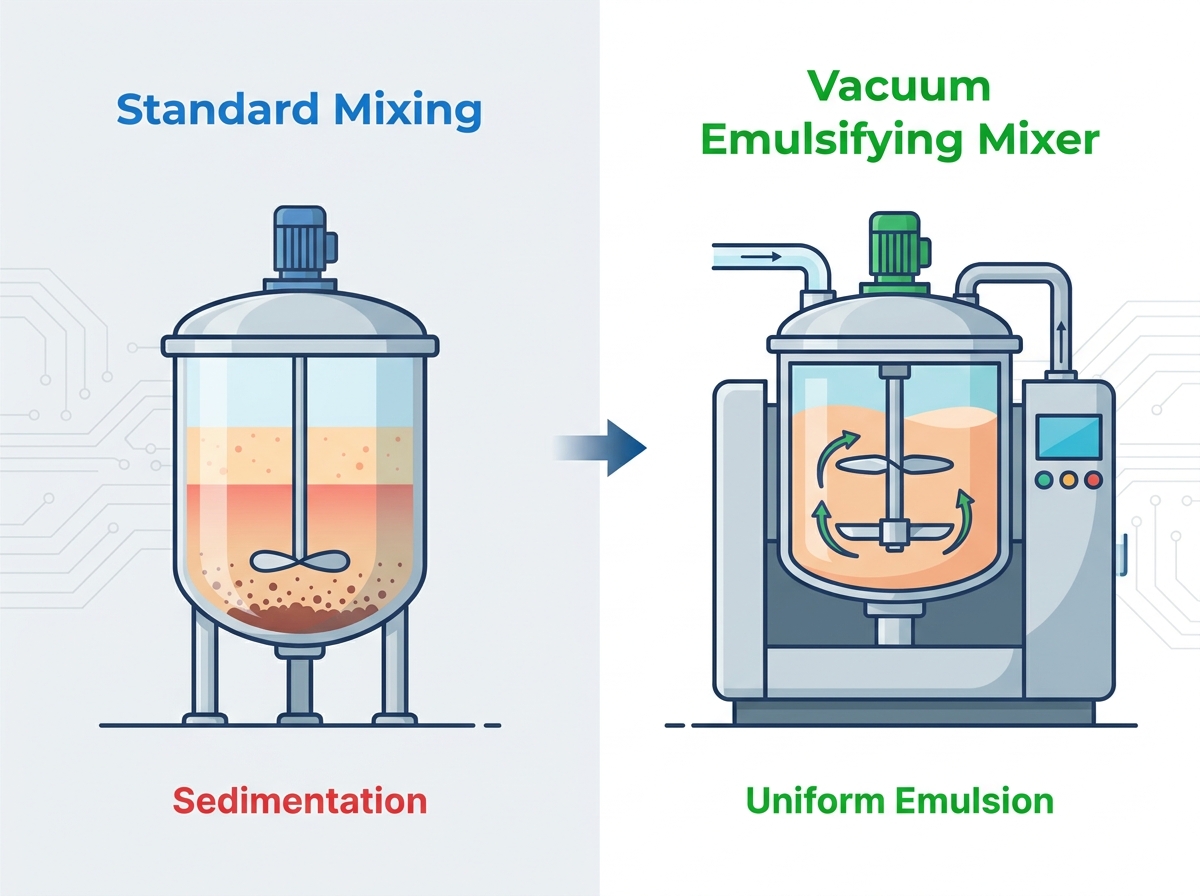
The Vacuum Emulsifying Mixer: A Technical Evaluation for Anti-Settling
Vacuum Degassing for Structural Integrity
Operating under negative pressure prevents air incorporation during the critical wetting and emulsification phases. A Vacuum Emulsifying Mixer pulls a vacuum on the entire vessel. This removes existing air from powders and prevents surface air from being whipped into the liquid. A void-free emulsion matrix directly correlates with increased resistance to particle settling. Without air bubbles disrupting the rheology, the continuous phase maintains a uniform yield stress, holding pigments and droplets firmly in suspension.
Vacuum degassing also improves the specific gravity of the final product. When you eliminate entrapped air, the product becomes denser and more uniform. This is critical for accurate filling operations. If your batch is full of micro-bubbles, the volume will fluctuate, leading to under-filled containers and regulatory compliance issues. By pulling a hard vacuum during the homogenization phase, you ensure a dense, stable, and perfectly uniform product that fills consistently every time.
High-Shear Rotor-Stator Homogenization
The core of this technology is the homogenizing component, typically located at the bottom or inline of the vacuum vessel. The rotor spins at high speeds within a stationary stator. This generates intense hydraulic and mechanical shear forces. These forces physically tear apart agglomerates and reduce droplet size to a uniform distribution. By drastically reducing the particle radius, you directly counter the variables in Stokes' Law, slowing the rate of sedimentation to a near halt.
The tight clearance between the rotor and stator is where the actual work happens. As the product is drawn into the workhead, it is subjected to extreme turbulence and cavitation. This mechanical energy shatters the primary particles and forces the emulsifiers to coat the newly exposed surfaces instantly. This rapid coating prevents re-agglomeration. The result is a sub-micron emulsion that remains stable under extreme temperature fluctuations and long-term storage.
Scraped Surface Agitation (Counter-Rotating Blending)
To support the high-shear zone, the vessel utilizes Teflon-lined scrapers that continuously sweep the inner walls. This counter-rotating blending ensures uniform heat transfer. It prevents localized thermal degradation of sensitive emulsifiers near the heating jacket. More importantly, it eliminates dead zones. The scrapers physically push unmixed material off the walls and direct it down into the high-shear rotor-stator, ensuring 100% of the batch receives uniform mechanical dispersion.
This macro-mixing action is just as critical as the micro-mixing provided by the homogenizer. If the bulk fluid does not circulate efficiently, the homogenizer will only process the material immediately surrounding it. The counter-rotating agitators create a complex flow pattern that folds the product over itself, forcing every ounce of the batch through the high-shear zone multiple times. This guarantees absolute uniformity from the first jar filled to the last.
Comparison of Mixing Technologies for Cosmetic Stability | ||
Feature | Standard Propeller Agitator | Vacuum Emulsifying Mixer |
|---|---|---|
Aeration Control | High air entrapment (vortexing) | Zero air entrapment (vacuum degassing) |
Particle Size Reduction | Poor (macro-mixing only) | Excellent (sub-micron homogenization) |
Dead Zones | Common at walls and bottom | Eliminated via scraped surface agitation |
Thermal Uniformity | Inconsistent | Highly uniform |
Powder Induction | Surface dumping (dusting) | Sub-surface vacuum induction |
Optimizing the Lotion Manufacturing Process to Prevent Re-Clumping
Strategic Order of Addition, Wetting, and Dynamic Speed Profiling
The sequence of introducing rheology modifiers, pigments, and active ingredients defines the success of the lotion manufacturing process. You must hydrate gums fully before adding heavy pigments. If you add pigments before the structural network is formed, they will immediately sink to the bottom of the vessel. Adjusting mixing speeds is also critical. Use low speeds during initial wetting to prevent dusting, then ramp up to high-speed homogenization once the powders are fully submerged.
Vacuum induction allows you to draw powders directly into the high-shear zone below the liquid level. This prevents surface agglomeration, commonly known as "fish eyes," ensuring immediate and uniform dispersion. By pulling the powders through a valve directly into the rotor-stator, you eliminate the risk of operator error during manual dumping. The powders are instantly wetted and sheared, preventing them from floating on the surface or sticking to the agitator shaft.
Integrating Auxiliary Dispersion Equipment: Pre-Dispersion and Milling
Sometimes, raw materials require processing before entering the main vessel. You must know when to integrate auxiliary equipment like ball mills or inline media mills with your primary anti-settling mixing system. Hard pigments, such as certain grades of iron oxide or ultramarine blue, often need pre-milling to reach the target micron size. A standard rotor-stator cannot fracture hard crystalline structures; it can only de-agglomerate them.
Once milled, these pre-dispersed pigment concentrates transition seamlessly into the main vacuum vessel. The main mixer then distributes the concentrate evenly throughout the emulsion without needing to perform the heavy milling work itself. This two-step process protects the homogenizer from excessive wear and ensures that the final product achieves the exact color match and stability required by the formulation.
Temperature Control and Cooling Rates
Cooling curves heavily impact emulsion crystallization and overall stability. If you cool a wax-based cream too quickly, the waxes crystallize unevenly, leading to graininess and eventual separation. Controlled cooling via jacketed vacuum vessels prevents this thermal shock. You must program the chilling system to drop the temperature at a specific rate, allowing the crystalline structure to form a strong, uniform network.
The scraped surface agitator ensures the temperature drops uniformly across the entire batch. Without scrapers, the product near the jacket cools rapidly and solidifies, insulating the rest of the batch. This leads to a hot core and a cold exterior, destroying the emulsion stability. Proper thermal management prevents immediate phase separation and protects against delayed sedimentation during transport and storage.
Equipment Selection: Homogenizing Mixer vs. Dedicated Anti-Settling Mixing System
Matching Equipment to Viscosity and Rheology
Selecting the right equipment depends entirely on the product's final viscosity. Low-viscosity serums behave differently than high-yield-stress creams. For a thin lotion, a standalone homogenizing mixer might provide enough shear to maintain stability. These inline units can process large volumes of thin liquids efficiently, relying on the pump to circulate the fluid through the workhead.
However, for thick pastes, heavy foundations, or high-viscosity masks, an inline homogenizer is insufficient on its own. You require a complete vacuum emulsifying vessel with heavy-duty counter-rotating agitation to move the highly viscous mass through the shear zone. If the agitator lacks the torque to push the thick cream down into the homogenizer, the batch will stratify, and the final product will fail stability testing.
Upstream High-Shear Mixing for Downstream Protection
Installing an inline homogenizer upstream of strainers or Heat-Transfer Short-Time (HTST) balance tanks vastly improves process flow. By reducing particle sizes prior to filtration, you prevent clogged strainers. This reduces maintenance downtime and extends equipment service life. When operators do not have to stop the line to clean blocked filters, overall plant efficiency skyrockets.
Upstream shear ensures that no large agglomerates make it into the downstream piping, protecting sensitive pumps and filling nozzles from abrasive wear. Hard agglomerates act like sandpaper on positive displacement pumps and rotary valves. By eliminating these particles early in the process, you protect your capital equipment and ensure a smooth, uninterrupted transfer to the packaging line.
Scalability and Process Translation
Scaling from a benchtop formulation to production volumes presents significant challenges. What works in a 2-liter beaker often fails in a 2000-liter tank. You must maintain consistent tip speeds, shear rates, and vacuum levels across different equipment sizes. Simply scaling up the volume without adjusting the mechanical parameters will result in a completely different product.
Work closely with equipment manufacturers to calculate the exact scale-up parameters. Ensuring geometric similarity between the lab mixer and the production vessel is vital for replicating the exact shear profile and preventing unexpected sedimentation at scale. You must match the rotor diameter, stator slot size, and agitator sweep area to guarantee that the production batch mirrors the lab sample perfectly.
Sanitary Design and Compliance (CIP/SIP)
Hygienic design prevents cross-contamination. Microbial growth degrades chemical stabilizers, leading to rapid emulsion breakdown and sedimentation. If bacteria consume your thickeners, the viscosity drops, and the pigments sink. Modern cosmetic mixing equipment must feature flush-mounted valves, crevice-free interiors, and sanitary welds to eliminate areas where product can hide and spoil.
Clean-In-Place (CIP) and Sterilize-In-Place (SIP) capabilities are mandatory for high-volume production. Automated spray balls ensure thorough cleaning of the vessel walls and the complex rotor-stator assembly without requiring manual teardown. This automated cleaning cycle guarantees that no residual product or cleaning chemicals remain to contaminate the next batch, ensuring absolute product safety and stability.
Implementation Risks and Mitigation Strategies
The Risk of Over-Shearing
More shear is not always better. Excessive mechanical shear can physically degrade certain polymers, like carbomers, breaking their molecular chains. It can also rupture delicate encapsulations, paradoxically leading to instability and weeping. If you run the homogenizer too long, you destroy the very structural network you are trying to build.
To mitigate this risk, utilize variable frequency drives (VFDs) on all mixer motors. Establish precise shear-time profiles during validation batches. Monitor the viscosity closely and stop the homogenization phase exactly when the target particle size is reached. Do not rely on arbitrary time limits; use empirical data to control the shear input.
Maintenance of Vacuum Integrity and Mechanical Seals
A vacuum mixer is useless if it leaks air. Failing mechanical seals or degrading vacuum pump performance introduce air back into the batch, ruining the degassing process. The operational risk of compromised seals includes product contamination and catastrophic batch failure. If barrier fluid leaks into the cosmetic product, the entire batch must be scrapped.
Mitigate this by implementing strict preventative maintenance schedules. Select double mechanical seals equipped with appropriate, compatible barrier fluids to ensure absolute vacuum integrity over years of daily operation. Monitor seal pressure gauges daily and replace wear parts before they fail during a critical production run.
Conclusion
Audit your current mixing process to identify points of aeration and inadequate shear that contribute to sedimentation.
Define your maximum viscosity and target particle size before selecting new homogenization equipment.
Implement strict temperature control protocols and dynamic speed profiling during the cooling phase to prevent thermal shock.
Schedule a factory acceptance test (FAT) using your most difficult formulation to verify the equipment's anti-settling capabilities.
FAQ
Q: What causes pigment sedimentation in color cosmetics?
A: Pigment sedimentation occurs when gravity overcomes the yield stress of the continuous phase. This is usually due to inadequate particle size reduction during mixing or insufficient dispersant coverage, allowing heavy particles to sink.
Q: Why does my emulsion cream even with the right emulsifiers?
A: Creaming often happens because entrapped air micro-bubbles attach to oil droplets, increasing their buoyancy. Open-air mixing introduces this air. Vacuum degassing is required to remove voids and stabilize the emulsion matrix.
Q: Can a standard liquid mixer handle high-viscosity creams?
A: No. Standard liquid mixers lack the torque and scraped-surface agitation needed to move thick creams. They create dead zones where material remains unmixed, leading to localized separation and inconsistent texture.
Q: How does a rotor-stator homogenizer prevent settling?
A: A rotor-stator applies intense mechanical and hydraulic shear to tear apart agglomerates. By reducing droplets and particles to a uniform, sub-micron size, it drastically slows the rate of settling as defined by Stokes' Law.
Q: What is the risk of over-shearing a cosmetic formulation?
A: Over-shearing can break the molecular chains of sensitive polymers and rheology modifiers. This destroys the structural network of the continuous phase, causing a sudden drop in viscosity and immediate physical instability.
Q: How do vacuum mixers handle dry powder induction?
A: Vacuum mixers use negative pressure to draw dry powders directly into the high-shear zone below the liquid surface. This prevents dusting, eliminates surface agglomeration, and ensures immediate, uniform wetting of the solids.


