


How to Prevent Foaming During Liquid Soap Mixing


Excess aeration during surfactant homogenization creates immediate production bottlenecks. Trapped air forms persistent foam that disrupts filling accuracy, alters product stability, and complicates packaging lines. Transitioning from small-batch processing to industrial-scale manufacturing exposes a major failure point: relying on manual mixing methods inherently prone to air entrainment. The rudimentary bucket-and-stick approach relies on crude manual aeration, which fails when scaling up. Achieving a consistent, clear product requires professional-grade architecture designed for controlled, low-foam processing. Moving from variable, manual batching to precision engineering is essential. It allows you to scale production while maintaining strict quality control. By understanding the mechanical origins of foam, operators can implement engineered solutions to refine output. This ensures product longevity and maintains high throughput without the recurring frustration of unwanted bubbles.
Aeration is primarily a function of blade geometry, shear speed, and vessel geometry rather than ingredient choice alone.
Industrial homogenization requires vacuum-integrated systems to remove micro-bubbles before they stabilize as foam.
Scaling production requires moving from top-entry stirrers to bottom-entry or recirculating systems to eliminate vortex-induced air entrainment.
Proper agitation control in detergent liquid mixing equipment is the first line of defense for achieving product consistency.
The Science of Foam in Industrial Liquid Soap Manufacturing
To eliminate foam, you must first understand the mechanics of vortexing. When an impeller rotates in an unbaffled tank, it imparts centrifugal force to the fluid. The fluid pushes against the tank walls and rises, creating a depression in the center. This central vortex acts as a physical funnel, sucking atmospheric air directly into the high-shear zone of the agitator blades. Once the air is chopped into micro-bubbles, the chemical properties of the surfactants take over.
Surfactants possess hydrophilic (water-loving) heads and hydrophobic (water-repelling) tails. They naturally migrate to the air-water interface of these micro-bubbles. The hydrophobic tails point inward toward the trapped air, while the hydrophilic heads point outward into the water. This alignment creates a highly stable, elastic film around the bubble, preventing it from bursting. Manual mixing techniques completely fail to manage this dynamic. Stick blenders and open-top drum mixers operate with uncontrolled shear rates and zero vortex suppression, whipping air into the batch continuously.
The downstream impact of this aeration is severe. Aerated liquid soap has a lower specific gravity. When you run this aerated product through a volumetric piston filler, the machine dispenses the correct volume, but the actual mass is underweight. You end up shipping partially empty bottles once the foam eventually settles. Furthermore, trapped oxygen accelerates the oxidation of fragrances and preservatives, drastically reducing the shelf life of the final product.
Water quality acts as a massive variable in foam stability. Industrial facilities must use distilled or reverse-osmosis (RO) de-ionized water. Standard municipal water contains calcium and magnesium cations. These hard water ions bind aggressively with anionic surfactants, forming insoluble precipitates known as soap scum. This reaction depletes the active surfactant concentration required for cleaning and alters the fluid's rheology. It destabilizes the intended emulsion and creates a chaotic fluid dynamic that traps larger, irregular air pockets. Upgrading to a proper industrial liquid mixing machine allows facilities to integrate closed-loop RO water feeds, eliminating mineral contamination entirely.
Evaluating Liquid Soap Mixing Machine Designs for Foam Control
To stop foam at the source, you must engineer the tank geometry to suppress vortex formation. This is achieved through strategic baffle placement. Baffles are vertical plates welded to the interior walls of the mixing vessel. They interrupt the radial flow generated by the impeller, converting it into axial (up and down) flow. This axial flow pattern promotes rapid top-to-bottom turnover without allowing the surface to draw down into a funnel.
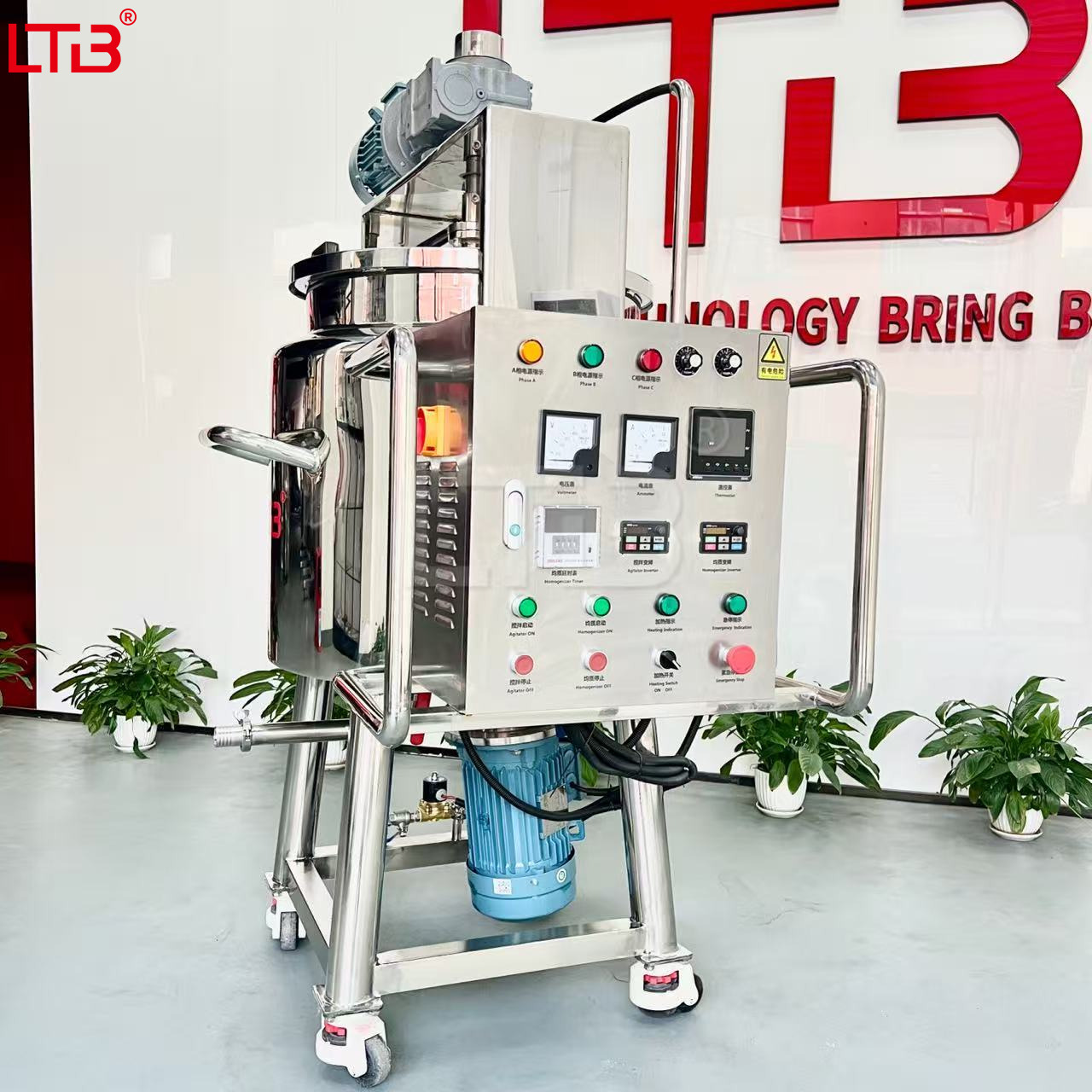
Vacuum homogenization represents the most aggressive and effective mechanical solution for de-aeration. By sealing the vessel and pulling a negative pressure (typically between -0.06 and -0.09 MPa), the system alters the atmospheric conditions above the liquid. According to Boyle's Law, as pressure decreases, the volume of a gas increases. The micro-bubbles trapped in the viscous soap expand, increasing their buoyancy. They rapidly rise to the surface and burst. A high-quality shampoo detergent homogenizing mixer utilizes this vacuum capability continuously during the high-shear phase, ensuring that air is extracted the moment it is introduced.
Balancing the shear rate against aeration requires precise agitator selection. High shear is mandatory for breaking down polymer thickeners and creating stable emulsions. However, excessive shear at the wrong fluid depth causes cavitation and turbulence. You need a rotor-stator workhead that pulls material into the shear zone and expels it horizontally, rather than churning the surface.
Bottom-entry agitators solve this depth issue entirely. By mounting the rotor-stator workhead at the lowest point of the vessel, the high-shear zone remains deeply submerged even during small batch runs. This configuration eliminates the long, vibrating shafts associated with top-entry mixers. It also removes the mechanical seal from the top of the tank, closing off a common entry point for ambient air leaks and protecting the vacuum integrity of the vessel.
Critical Features for High-Volume Production Lines
Scaling up to high-volume production demands a transition to closed-system processing. Open-top tanks expose the batch to ambient air, dust, and biological contaminants. Closed systems utilize hard-piped manifolds and vacuum suction to draw raw materials directly into the fluid bed, well below the surface. This sub-surface addition prevents dry powders from floating and clumping, which often traps dry air pockets within the mixture.
In-line homogenization takes this a step further. Instead of relying solely on an in-tank agitator, modular liquid soap production line equipment pumps the base liquid through an external rotor-stator loop. The materials are sheared under pressure inside a sealed pipe, completely isolated from the atmosphere, before being recirculated back into the main tank. This keeps the primary vessel calm and drastically reduces surface turbulence.
Variable Frequency Drives (VFDs) provide the necessary control over motor RPM. Liquid soap formulations undergo drastic viscosity changes. You start with water, add surfactants, and eventually introduce salts or polymers to spike the viscosity. If the agitator runs at a fixed, high speed as the liquid thickens, it will tear the fluid apart, creating a whipping effect that folds air into the gel network. VFDs allow operators to program specific speed profiles for each phase of the batch, maintaining laminar flow regardless of the fluid's thickness.
Temperature control directly impacts fluid rheology and foam stability. Jacketed vessels circulate steam, hot water, or chilled water to maintain exact batch temperatures. Surfactants have specific cloud points and dissolution temperatures. If the batch runs too cold, the surfactants will not fully hydrate, leading to clumps that require excessive, air-entraining agitation to break apart. If the batch runs too hot, the viscosity drops, and the fluid becomes highly susceptible to turbulent splashing.
Decision Framework: Choosing the Right Equipment for Your Facility
Selecting the right equipment requires analyzing your throughput capacity against your batch size. Portable mixing totes and clamp-on stirrers max out around 500 liters per shift. Beyond that volume, the manual labor required to manage foaming and settling times destroys your profit margins. Moving to fixed-installation, automated tanks becomes a financial necessity to maintain output.
When evaluating options, you must decide between off-the-shelf units and custom engineering. Standard tanks often feature generic anchor stirrers. If your formulation includes highly viscous carbomer gels or sensitive natural surfactants, a generic blade will likely cause localized heating and aeration. Partnering with a custom liquid soap mixer supplier allows you to specify exact scraper blade geometries, stator gap tolerances, and baffle angles tailored to your specific fluid rheology.
Scalability must factor into the initial purchase. A standalone liquid soap mixing machine should feature modular ports and load cell mounts. This allows you to retrofit automated dosing pumps, mass flow meters, and secondary de-aeration modules as your facility expands, rather than replacing the entire tank.
Hygienic compliance dictates the lifespan of the equipment. The wetted parts of the tank must be constructed from 316L stainless steel. Liquid soaps often utilize sodium chloride for thickening, which causes severe chloride pitting and corrosion in standard 304 stainless steel. The interior surfaces should be mechanically polished to an Ra value of 0.4 micrometers or better to prevent microscopic product buildup. Integrated Clean-in-Place (CIP) spray balls are mandatory to ensure thorough sanitation between batches without requiring confined space entry.
Operational Feature | Manual / Open-Top Batching | Industrial Closed-System Processing |
|---|---|---|
Air Exposure | High (Constant atmospheric contact) | Zero (Vacuum sealed environment) |
Fluid Flow Control | Vortex-prone (Uncontrolled shear) | Baffled / Bottom-entry (Axial flow) |
Agitator Speed Control | Fixed RPM or Manual adjustment | Precision VFD (Automated ramping) |
De-aeration Method | Manual settling (Requires hours/days) | Active Vacuum Removal (Instantaneous) |
Material Addition | Top-dumping (Traps dry air) | Sub-surface vacuum induction |
Implementation Risks and Mitigation Strategies
Even the most advanced machinery cannot compensate for poor operational procedures. Operator error during the startup sequence is the leading cause of batch aeration. When operators rush the initial mixing phases, they bypass the mechanical safeguards built into the equipment.
Follow these standard operating procedures to mitigate startup risks:
Verify the liquid level completely covers the primary agitator blades before engaging the motor.
Initiate the VFD at the lowest possible RPM to establish a gentle axial flow without breaking the surface tension.
Introduce dry powders through a sub-surface vacuum port rather than dumping them over the top of the fluid bed.
Ramp up the homogenizer speed only after the powders are fully wetted, dispersed, and submerged.
Viscosity mismatches frequently stall production. When operators add thickening agents too rapidly, the fluid undergoes a sudden rheological shift. The localized viscosity around the agitator spikes, exceeding the motor's torque capacity. The agitator struggles, creating localized cavitation—low-pressure zones where the liquid actually boils at room temperature, generating vapor bubbles that become trapped in the gel network.
Routine calibration and mechanical maintenance prevent hardware-induced aeration. The mechanical seals on the agitator shafts degrade over time. When a seal fails on a vacuum-rated tank, it acts as a vacuum leak, pulling ambient air directly down the shaft and into the product. Operators must inspect seal flush lines and monitor vacuum drop rates daily. Bent shafts or worn bearings cause impeller vibration, which physically beats air into the fluid.
Many facilities attempt to solve these mechanical failures by dumping chemical anti-foaming agents into the batch. While this suppresses the foam, it alters the product's skin-feel, reduces lather during consumer use, and adds unnecessary recurring costs to the bill of materials. Relying on properly engineered detergent liquid mixing equipment maintains the chemical purity of your formulation.
When troubleshooting, isolate the variables. Foam issues often stem from incorrect surfactant ratios, degraded raw materials, or trace mineral contamination in the water supply, rather than a mechanical failure. Always verify your ingredient specifications and water hardness before tearing down the mixer.
Conclusion
Transitioning from rudimentary manual mixing to precision industrial engineering eliminates the bottlenecks associated with aerated surfactants. Achieving a high-yield, stable product relies heavily on controlling fluid dynamics through vacuum capabilities, strategic baffle placement, and precise VFD agitation. When shortlisting new equipment, prioritize bottom-entry homogenizers and closed-loop recirculation systems. These features directly attack the mechanical origins of foam, ensuring your production lines run at maximum throughput without waiting for batches to settle. Strategic investment in the right mixing technology directly increases product yield, ensures volumetric filling accuracy, and protects your brand's quality standards.
Take the following steps to optimize your current operation:
Audit your existing mixing sequences to pinpoint exactly when vortexing and air entrainment occur during the batch cycle.
Measure the specific gravity of your finished product against the theoretical specific gravity to quantify your current aeration levels.
Inspect your water filtration systems to ensure zero hard-water mineral contamination is reaching the mixing vessel.
Consult with an engineering-focused equipment manufacturer to determine if your current tanks can be retrofitted with vacuum seals or bottom-entry drives.
FAQ
Q: How does a vacuum mixer specifically reduce foaming compared to standard atmospheric mixers?
A: A vacuum mixer seals the vessel and pulls a negative pressure during the blending cycle. This pressure drop causes entrapped micro-bubbles to expand rapidly due to increased buoyancy. The enlarged bubbles are forced to the surface where they burst and are extracted by the vacuum pump. This mechanical de-aeration prevents surfactants from stabilizing the air pockets, eliminating the need for chemical defoamers.
Q: At what stage of the batch process is foam most likely to occur, and how should it be managed?
A: Foam typically occurs during the initial introduction of dry surfactants into the water phase, or during the final thickening stage if the agitator speed remains too high. Manage this by utilizing sub-surface vacuum induction for raw materials. Always use a Variable Frequency Drive to start the agitator at a low RPM, only increasing speed once the powders are fully wetted and submerged.
Q: Can industrial homogenizers be retrofitted to reduce air entrainment in existing detergent liquid mixing equipment?
A: Retrofitting existing atmospheric tanks with vacuum capabilities is rarely viable. Standard tanks lack the wall thickness and structural integrity to withstand negative pressure without collapsing. While you can upgrade impellers or weld new baffles to reduce vortexing, achieving true mechanical de-aeration requires investing in a purpose-built, closed-circuit vacuum mixing system designed for high-volume production.
Q: Does the viscosity of the liquid soap dictate the type of agitator blade required?
A: Yes. Low-viscosity fluids require marine-style propellers or pitched-blade turbines to generate high axial flow and keep the mixture circulating. As the soap thickens into a gel, these blades lose efficiency. High-viscosity products require anchor or scraper blades that sweep the tank walls to prevent localized heating, combined with a high-shear rotor-stator to disperse the surfactants without folding in air.
Q: What are the primary indicators that my current mixing equipment is inefficiently handling surfactants?
A: The most obvious indicators are persistent foam heads that require hours to settle, and volumetric filling machines dispensing underweight bottles. You may also notice a cloudy or opaque appearance in formulas that should be crystal clear, which is caused by suspended micro-bubbles. Excessive vibration or chattering from the agitator shaft also indicates the blades are struggling with the fluid rheology.
Q: Why is distilled or de-ionized water critical in industrial mixing despite the presence of high-shear homogenization?
A: Standard tap water contains calcium and magnesium ions. These hard water minerals react aggressively with anionic surfactants to form insoluble precipitates known as soap scum. This chemical reaction depletes the active surfactants, destabilizes the emulsion, and alters the fluid dynamics, making the batch highly susceptible to trapping air. De-ionized water ensures the chemical matrix remains pure and stable.


