


Industrial Vacuum Emulsifier Buying Guide for Cosmetic Manufacturers


Unstable emulsions, aeration, and batch rejections carry severe financial and reputational costs in cosmetic manufacturing. Scaling production for complex formulations like creams, lotions, and gels presents a major challenge on the factory floor. You must maintain perfect texture and stability while ensuring strict GMP compliance. A single compromised batch can disrupt supply chains, waste expensive active ingredients, and damage brand trust.
Selecting the right machinery is the most critical step in scaling your operations. A properly configured Vacuum Emulsifier mitigates production risks and standardizes output across multiple shifts. By understanding the core mechanical and thermal evaluation criteria, you can optimize your production line for maximum efficiency. This guide breaks down the essential technical dimensions you need to evaluate before finalizing equipment specifications.
Key Takeaways
High shear vacuum emulsifiers eliminate air entrapment during the mixing phase, preventing oxidation, bacterial growth, and texture inconsistencies in cosmetic formulas.
Matching equipment specifications—such as rotor-stator shear rates, viscosity limits, and thermal transfer efficiency—to specific product lines is critical for successful phase inversion and emulsion stability.
Purchasing risks, including mechanical seal failures and non-compliant contact materials, must be mitigated through rigorous vendor evaluation and Factory Acceptance Testing (FAT).
Investing in a custom emulsifying machine often yields a higher long-term ROI for facilities handling highly viscous or proprietary rheological profiles compared to off-the-shelf models.
The Role of a Vacuum Emulsifier in Cosmetic Manufacturing Equipment
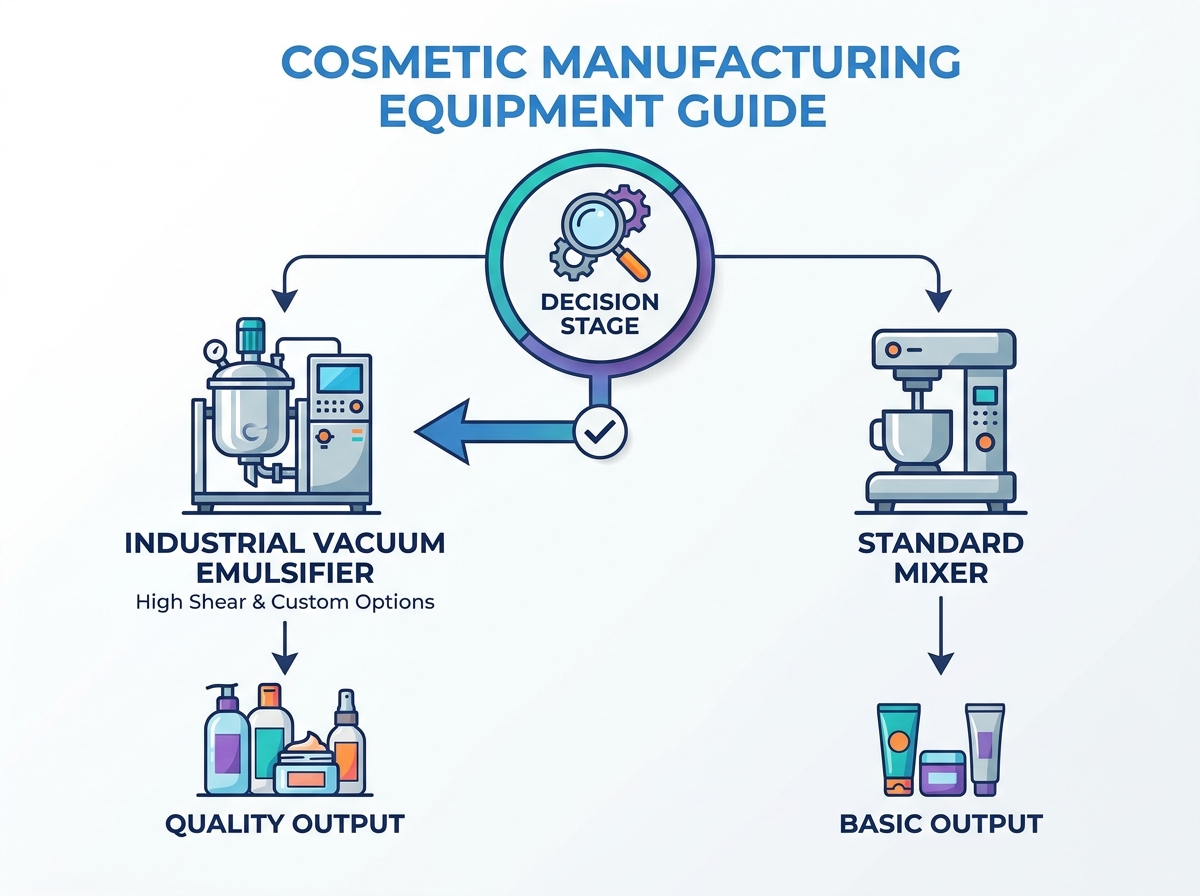
Traditional Mixers vs. Vacuum Homogenizer Systems
Conventional open-air mixing presents significant limitations for modern cosmetics. These older systems physically fold air into the product during agitation. This air entrapment leads to inconsistent particle size distribution, visible micro-bubbles in the final cream, and prolonged batch times as operators wait for the product to settle. Open-air mixing also exposes sensitive ingredients, like Vitamin C or botanical extracts, to rapid oxidation.
Vacuum environments fundamentally change the physics of emulsification. Negative pressure facilitates rapid deaeration. When you pull a vacuum down to -0.09 MPa, trapped air expands and escapes the viscous matrix. Removing these air bubbles improves emulsion stability and extends product shelf life by eliminating the oxygen that bacteria need to thrive. Single-pot vacuum processing optimizes overall efficiency. This method reduces total batch cycle times by up to 60% compared to multi-vessel open-air systems because heating, dispersing, emulsifying, and cooling happen in one enclosed space.
Process Variable | Traditional Open-Air Mixers | Vacuum Homogenizer Systems |
|---|---|---|
Air Entrapment | High risk of micro-bubbles and foaming | Complete deaeration via negative pressure |
Batch Cycle Time | Prolonged, often requiring multiple transfer vessels | Up to 60% faster single-pot processing |
Oxidation Risk | High exposure to ambient air degrades actives | Minimal to none; oxygen is evacuated |
Particle Size | Inconsistent distribution, prone to separation | Uniform, highly controlled distribution (2-5 microns) |
Material Handling | Manual dumping creates dust and contamination risks | Vacuum suction pulls powders directly into the fluid bed |
Defining Success Criteria for Your Production Line
You must establish target droplet size and homogenization requirements based on your specific product. Nano-emulsions require vastly different mechanical forces than standard macro-emulsions. Defining these parameters early ensures you select the correct cosmetic manufacturing equipment. If you under-spec the motor, the machine will stall on thick pastes. If you over-spec, you waste capital and energy.
Sensory and rheological targets dictate machine specifications. Achieving a silky texture, high gloss, and premium skin-feel requires optimizing droplet size uniformity. You typically need to narrow the distribution to between 2 and 5 microns. You must also calculate realistic batch cycle times, throughput expectations, and minimum fill volumes. A machine designed for 1000L batches will struggle to properly mix a 200L run because the homogenizer head might not be fully submerged, leading to splashing and poor shear.
Core Evaluation Dimensions for an Industrial Vacuum Emulsifier
High Shear Homogenization and Rotor-Stator Design
The mechanics of a high shear vacuum emulsifier dictate product quality. The rotor-stator gap tolerances directly impact particle size reduction. Tighter gaps produce finer emulsions but require more robust motor power to overcome the increased hydraulic resistance. The stator features precision-machined slots or holes. As the rotor spins at high speeds (often 3000 RPM or more), it draws the cosmetic fluid into the center of the workhead and expels it radially through the stator. This creates intense mechanical and hydraulic shear.
Configuration analysis is necessary for optimal performance. You must compare bottom-entry homogenizers, top-entry homogenizers, and external inline recirculation loops. Bottom-entry units excel at processing high-viscosity night creams because gravity feeds the heavy material directly into the shear zone. Top-entry units are easier to clean but can struggle with very thick pastes. Inline loops often work best for low-viscosity serums or large-scale continuous processing. Always match shear rates, including RPM and tip speed, to your formula viscosity. Tip speed, calculated by the rotor diameter and RPM, is the true measure of shear force.
Vacuum System Performance and Deaeration
Effective air removal in dense cosmetic pastes requires specific vacuum levels. You must define these requirements in MPa, bar, or Torr. Weak vacuum systems leave micro-bubbles trapped in thick creams, which later expand during filling and cause weight variations in the final packaging. A standard cosmetic vacuum system should reliably pull and hold -0.09 MPa.
Sealing integrity under extreme vacuum is absolutely critical. High-performance lip seals and mechanical seals with barrier fluids prevent micro-leakage. They maintain sterile conditions during the vacuum phase. If a seal fails, the machine pulls ambient, unsterilized air into the batch, ruining the product. Sustained vacuum pressure prevents the oxidation of active ingredients, vitamins, and essential oils. It also allows operators to use vacuum suction to draw raw materials, especially dusty powders like titanium dioxide or carbomer, directly into the mixing vessel below the liquid level, preventing clumps.
Temperature Control: Heating and Cooling Jackets
Thermal transfer efficiency dictates batch speed. You must evaluate steam heating, electric heating, and water or oil circulation systems. Steam provides rapid heating and is standard in large facilities with existing boilers. Electric heating uses internal elements to heat a thermal fluid within the jacket; it offers simpler installation for smaller plants but slower ramp-up times.
Vessel design impacts thermal performance. Double-jacketed and triple-jacketed vessels allow for rapid heating and cooling cycles. A triple-jacketed design includes an outer layer of insulation, protecting operators from burns and reducing energy loss. Precise temperature regulation is critical for successful phase inversion. It ensures proper ingredient melting points and prevents the degradation of heat-sensitive actives. Cooling is often the longest phase of the batch cycle. Utilizing chilled water through a well-designed dimple jacket can cut cooling times in half compared to standard municipal water.
Agitation and Scraping Mechanisms
PTFE wall scrapers play a vital role in the mixing process. They prevent localized overheating, known as burn-on, at the vessel walls during the heating phase. Scrapers ensure uniform thermal distribution throughout the batch by constantly moving material from the hot vessel wall into the cooler center. Without effective scraping, the product at the wall degrades, while the center remains un-melted.
Agitation setups must handle non-Newtonian cosmetic fluids. You should compare co-axial, counter-rotating, and single-way agitation configurations. Counter-rotating systems feature an outer anchor agitator moving in one direction and inner blades moving in the opposite direction. This provides superior blending for highly viscous, shear-thinning creams. The opposing forces create complex flow patterns that prevent dead zones in the tank.
Scalability, Automation, and GMP Compliance
Sizing the Equipment: From Lab Scale to Bulk Production
Understanding vessel capacity prevents production bottlenecks. Total vessel volume differs significantly from actual working capacity. Working capacity is typically only 70 to 80 percent of the total volume. The remaining headspace is necessary to accommodate the physical expansion of the product during heating and to provide room for the vacuum to pull out air without sucking product into the vacuum pump.
Minimum batch size limitations pose challenges during scale-up. You must ensure scale-up predictability from R&D lab mixers to full-scale production units. Geometric similarity between lab and production vessels is essential. If your lab mixer has a different rotor-stator geometry or tank aspect ratio than your production machine, the shear rates will not match. This results in a lab formula that fails on the factory floor. Always calculate the tip speed of the lab unit and ensure the production unit can match it.
Material Standards and Sanitary Design
Material standards are non-negotiable in cosmetic manufacturing. You require 316L stainless steel on all product-contact parts. 316L contains molybdenum, which provides superior resistance to pitting and corrosion from chlorides and acidic cosmetic ingredients. Use 304 stainless steel for non-contact structural components like the frame and outer cladding to manage costs without sacrificing hygiene.
Surface finish requirements demand Ra values typically below 0.4 µm. A mirror polish prevents product from adhering to the walls and harboring bacteria. Seamless integration with Clean-In-Place (CIP) and Sterilize-In-Place (SIP) systems prevents cross-contamination between batches. Spray balls must be positioned to hit every internal surface, including the underside of the agitator blades. You must verify international compliance certifications, including FDA, GMP, CE, and ASME pressure vessel standards. If the vessel is pressurized for SIP, it must carry an ASME stamp.
PLC Controls and Recipe Management
Modern facilities transition from manual push-button operation to automated recipe execution. Advanced PLC and HMI systems, such as Siemens or Allen-Bradley, ensure absolute batch consistency. Operators select a recipe, and the PLC automatically controls the heating ramp rates, agitator speeds, homogenizer run times, and vacuum levels. This eliminates the variability of human operators.
Automated data logging is mandatory for quality control. It provides batch traceability, parameter monitoring, and data for quality assurance audits. If a batch fails QC, the engineering team can review the data logs to see exactly what went wrong—whether a temperature dropped too fast or the homogenizer didn't run long enough. Automation eliminates human error during complex multi-phase emulsification.
Vetting a Vacuum Emulsifier Manufacturer: Risks and Customization
Standard vs. Custom Emulsifying Machine Configurations
Choosing between off-the-shelf models and custom engineering requires careful analysis of your product portfolio. Standard models offer faster delivery and proven baseline performance. However, a custom emulsifying machine provides exact alignment with proprietary rheological profiles. If you manufacture heavy clay masks or stringy pomades, a standard agitator will likely fail.
You must weigh upfront capital expenditure against long-term adaptability. Custom additions enhance functionality and reduce manual labor. Consider powder induction systems that pull dry ingredients directly into the high-shear zone, eliminating airborne dust. Load cells mounted on the vessel legs allow for precise weighing of ingredients directly in the tank, bypassing the need for separate floor scales. Hazardous location ratings (explosion-proof motors and wiring) are mandatory if your formulas contain volatile ingredients like high concentrations of alcohol.
Framework for Evaluating a Vacuum Emulsifier Manufacturer
Assessing a vacuum emulsifier manufacturer requires looking beyond the sales brochure. Evaluate their engineering and R&D capabilities. Look for computational fluid dynamics (CFD) mixing analysis. A competent manufacturer can simulate your specific fluid viscosity in their tank design to prove there are no dead mixing zones before cutting any steel.
Validation support is crucial for regulatory compliance. The supplier must provide comprehensive documentation. This includes Installation Qualification (IQ) and Operational Qualification (OQ) protocols. These documents prove to auditors that the machine was installed correctly and operates exactly as specified. Investigate their global service infrastructure. Ask about remote troubleshooting capabilities via secure VPN connections to the PLC, field engineer dispatch times, and domestic parts availability.
Common Purchasing Risks and Mitigation Strategies
Overstated performance metrics present a major risk. Manufacturers may exaggerate homogenization speed under load. A motor that spins at 3000 RPM in water might bog down to 1500 RPM in a thick cream. You must mandate Factory Acceptance Testing (FAT) using your actual product or a highly accurate placebo. Do not sign off on the machine until you see it process your toughest formula.
Mechanical seal failures under high vacuum disrupt production and contaminate batches. Verify the inclusion of double mechanical seals equipped with dedicated cooling and lubrication fluid systems. If the seal runs dry, it will shatter. Substandard metallurgy and poor welds cause contamination and rust. Demand certified Material Test Reports (MTRs) to prove the steel is actually 316L. Require surface roughness certificates and third-party weld inspections to ensure there are no microscopic pits where bacteria can hide.
Conclusion
Selecting the right industrial equipment stabilizes production and ensures strict GMP compliance. It protects your brand reputation by guaranteeing consistent product quality across every batch. Prioritize manufacturers that offer transparent testing procedures, verifiable sanitary design, and robust engineering support.
Compile precise formulation viscosity data and shear requirements for all your current product lines.
Define exact minimum and maximum batch sizes required for your facility to ensure proper vessel sizing.
Request detailed technical specifications, CFD reports, and Material Test Reports from shortlisted vendors.
Schedule a comprehensive Factory Acceptance Test using your most challenging cosmetic formula before final payment.
FAQ
Q: What is the difference between an industrial vacuum emulsifier and a standard homogenizer?
A: An industrial vacuum emulsifier features integrated vacuum deaeration and multi-directional scraping functions. It enables single-pot processing for heating, mixing, and cooling. A standard homogenizer typically only performs stand-alone dispersion without vacuum or temperature control capabilities.
Q: How does a vacuum environment improve cosmetic cream stability?
A: A vacuum environment prevents the formation of micro-bubbles during high-speed mixing. Removing these bubbles prevents the oxidation of active ingredients. It also eliminates pockets where phase separation and microbial or bacterial growth can occur.
Q: What is the ideal shear rate for cosmetic lotions?
A: The ideal shear rate depends entirely on the specific formula's viscosity and target droplet size. Generally, achieving a uniform droplet size of 2 to 5 microns requires high tip speeds. Your manufacturer must calculate the exact RPM based on rotor-stator geometry.
Q: Why is a double-jacketed vessel necessary for emulsification?
A: A double-jacketed vessel allows for precise, rapid heating and cooling cycles using steam or chilled water. This thermal control is mandatory for successful phase inversion, melting solid waxes, and preventing the degradation of heat-sensitive active ingredients.
Q: How do PTFE wall scrapers improve the mixing process?
A: PTFE wall scrapers continuously sweep the inner surface of the vessel during agitation. They prevent thick cosmetic materials from sticking to the walls and burning. This ensures uniform thermal distribution and a completely homogeneous batch.


