


What Is a CIP Cleaning System and When Is It Needed?


Cleaning a production tank by hand may seem simple when a factory has one small vessel. The job becomes harder when the line includes closed tanks, pumps, fillers and long pipelines. Product can remain inside bends, valves and transfer lines even when the visible tank looks clean.
A CIP cleaning system circulates water and cleaning solutions through connected equipment without requiring workers to dismantle the full process line. CIP stands for clean-in-place. The system can send hot water, alkaline detergent and acid solution through tanks and pipes, then return or discharge the liquid according to the cleaning process.
CIP is widely used in food, cosmetics, pharmaceuticals, daily chemicals and other industries that process liquids. It can reduce repeated disassembly and make cleaning steps easier to control. However, the correct tank size, pump flow, temperature and control level must match the actual equipment being cleaned.
What Actually Happens During CIP Cleaning?
A clean in place system normally stores cleaning media in separate tanks and uses pumps to circulate them through production equipment. Pipelines are cleaned by flowing liquid through the circuit. Tanks may use spray balls, circulating flow or a fill-and-agitate method, depending on their design.
The cleaning solution must reach every product-contact surface with enough time, temperature, chemical concentration and mechanical action. Weak conditions may leave residue, while excessive conditions waste water, chemicals and energy.
The CIP cleaning system is therefore more than a set of stainless steel tanks. It is a cleaning loop that connects storage tanks, pumps, delivery lines, process equipment and return or drainage lines.
What Does a Typical CIP Cycle Look Like?
The exact program depends on the product residue and the factory’s cleaning standard. A common three-tank process may include:
Cleaning stage | Main purpose | Typical cleaning medium |
|---|---|---|
Pre-rinse | Remove loose product and reduce the amount of residue | Water |
Alkaline wash | Break down oils, fats and other organic residue | Alkaline cleaning solution |
Intermediate rinse | Remove alkaline solution and suspended soil | Water |
Acid wash | Address mineral scale and some inorganic deposits | Acid cleaning solution |
Final rinse | Remove remaining cleaning chemicals | Clean water |
Hot-water treatment | Support the required final hygiene step | Heated water |
Not every production line needs every stage. Cosmetic cream, beverage and liquid detergent do not leave the same residue. Chemical type, concentration, temperature and contact time should come from the factory’s approved procedure.
Cleaning and sanitizing are not identical. Buyers should define the required result before selecting the CIP cleaning system.
Why Use CIP Instead of Taking the Line Apart?
Manual cleaning still has a place in small or open equipment. It becomes less practical when operators must repeatedly disconnect pipes, pumps and valves. Reassembly also creates a risk of incorrect connections or damaged seals.
A well-planned CIP cleaning system can offer several operational benefits:
Less disassembly: Tanks and pipelines can be cleaned as a connected circuit.
More repeatable steps: Operators can follow the same sequence for time, temperature and circulation.
Shorter changeovers: Cleaning preparation and reassembly take less time.
Controlled chemical handling: Acid and alkaline solutions remain in designated tanks and pipelines.
Better access to closed equipment: Circulating liquid reaches areas that are difficult to scrub manually.
Easier scale-up: A growing line can use a planned cleaning loop instead of separate manual routines for every machine.
These benefits depend on proper design. Poor pipe layout, low flow or blocked spray devices can still weaken the result.
When Does a Production Line Need a CIP Cleaning System?
A production line should consider CIP when several of the following conditions apply.
The Equipment Is Closed or Difficult to Reach
Mixing tanks, storage tanks, filling machines and transfer pipelines contain surfaces that operators cannot easily reach. A CIP cleaning system can circulate liquid through these areas without opening every connection.
Product Changes Happen Frequently
Factories producing several formulas may clean between batches to control color, fragrance, flavor or active-ingredient carryover. When manual cleaning delays the next batch, CIP can make the changeover process more organized.
Residue Builds Up Inside Tanks and Pipes
Creams, lotions, syrups, oils and other products may coat surfaces. Mineral deposits can also build up over time. Alkaline and acid stages are used for different types of residue, so one cleaning solution should not be expected to remove everything.
The Line Has Several Connected Machines
Once a factory connects mixers, holding tanks, pumps, pipelines and filling equipment, separate manual cleaning becomes more difficult. A central CIP cleaning system can be designed around one or more cleaning circuits.
Cleaning Records Need to Be More Consistent
Central control can make time, temperature, liquid level and pump operation easier to monitor. A button-controlled system does not offer the same functions as a PLC configuration.
What Is Inside LTB’s Hot Water, Acid and Alkali System?
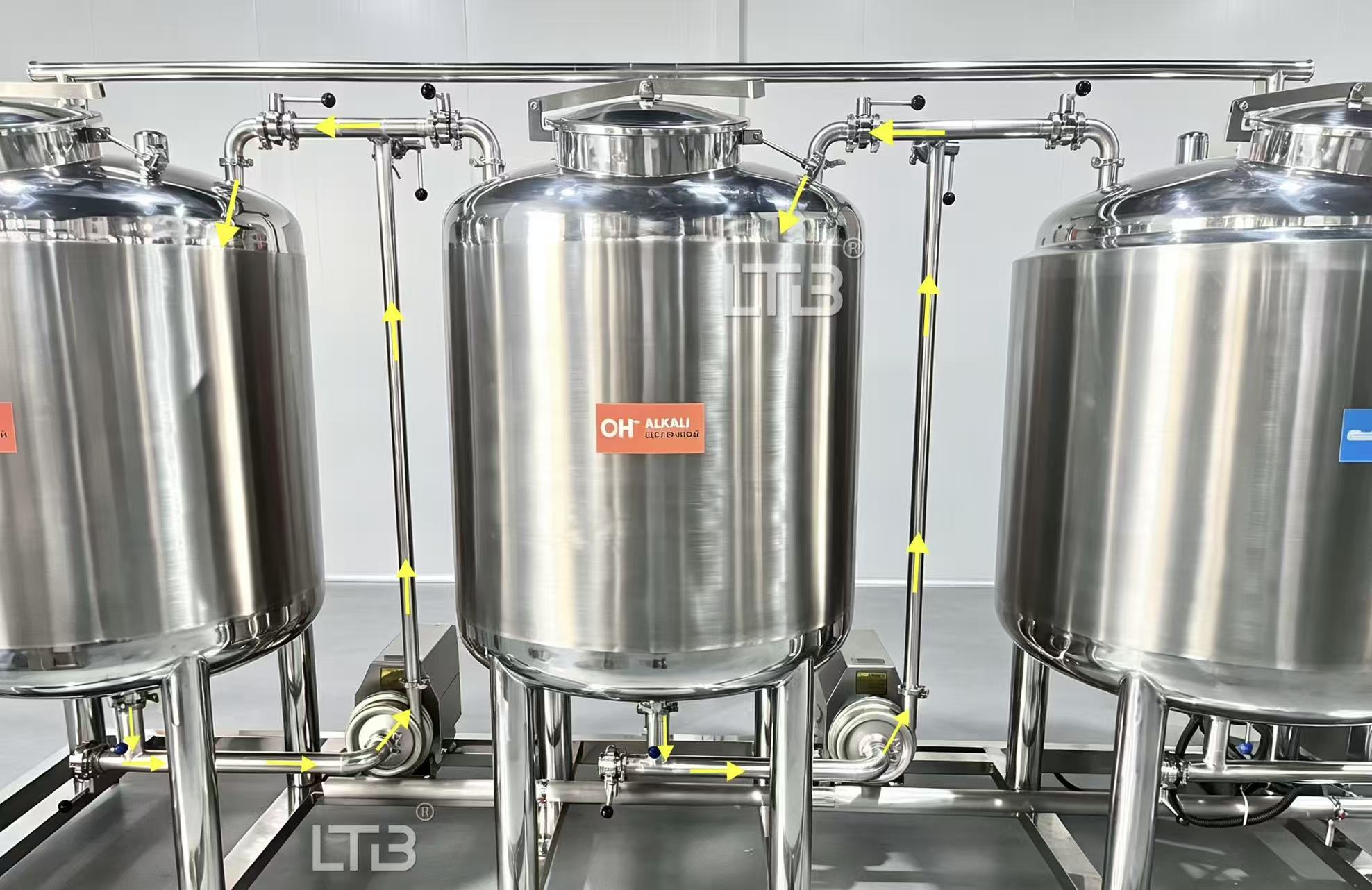
LTB’s hot water CIP cleaning system is designed around separate storage for hot water, acid solution and alkaline solution. The product page states that two-tank and three-tank arrangements are available, along with optional recovery tanks. Tank capacities can be selected according to the equipment and site conditions.
The listed product-contact material is SUS304 stainless steel. Tanks use sealed covers, and the inner surfaces are mirror polished. Electric heating is used, while a sanitary centrifugal pump moves cleaning liquid through the system.
Published specification | Available configuration |
|---|---|
Effective capacity | 100L or 500L |
Product-contact material | SUS304 stainless steel |
Tank arrangement | Two or three tanks; recovery tank optional |
Main media | Hot water, acid and alkaline cleaning solutions |
Heating method | Electric heating |
Heating power | 6kW for 100L; 27kW for 500L |
Pump type | Sanitary centrifugal pump |
Cover design | Sealed cover |
Control | Siemens PLC with touchscreen or push-button configuration |
The acid alkali CIP system stores different cleaning media separately. Its page also describes adjustable duration, liquid concentration and circulation speed. These settings must match the residue and cleaning target.
The listed controls do not mean every CIP cleaning system has the same automation. Confirm whether the quotation includes PLC recipe control, valve switching, temperature logging, chemical dosing or only central pump and heating controls.
How Does the Three-Tank 500L System Differ?
LTB also lists a CIP system for production equipment with three separate 500L tanks. The three tanks hold acid solution, alkaline solution and hot water.
Each tank has self-circulation, while cross-circulation moves media through the required circuit. Independent low-position drains help empty waste liquid, sediment and remaining media.
Published item | Three-tank configuration |
|---|---|
Tank volume | 500L + 500L + 500L |
Material | SUS304 or SUS316L |
Heating power | 27kW, based on volume |
Pump power | 2.2kW + 2.2kW + 2.2kW |
Voltage | 380V, 50Hz, three-phase; customizable |
Control | Touchscreen or button control |
Internal cleaning component | CIP ball |
Covers | Sealed covers |
The integrated control panel handles heating activation and pump start-stop. It also lists temperature control, current monitoring, liquid-level display, level alarm and power indication.
This model should not automatically be described as fully automatic. The product page offers touchscreen or button control, but it does not state that every version includes automatic valves, chemical dosing or programmed sequence control. If the project requires an automatic CIP system, those functions must be confirmed in the final configuration.
How Much Automation Does a CIP Cleaning System Need?
The right control level depends on line size, cleaning frequency and the number of circuits.
Control level | How it may work | Suitable situation |
|---|---|---|
Button control | Operators start pumps, heating and each cleaning step from a panel | Smaller systems with trained operators and simple cleaning routines |
Touchscreen control | Main settings and equipment status are managed through an interface | Lines needing easier central monitoring |
PLC sequence control | The system follows programmed steps using the specified valves and sensors | Repeated cleaning cycles that need closer process control |
The term automatic CIP system is sometimes used too broadly. A touchscreen does not prove that every valve, chemical dose and return path is automatic. Ask for a written sequence showing which actions require an operator.
How Is a CIP Cleaning System Sized?
CIP tank volume should match the liquid needed to fill and circulate through the loop. The calculation includes pipelines, tanks, pumps, fillers and the minimum operating level in the CIP tank.
A tank that is too small may not maintain circulation through the complete circuit. A tank that is much larger than necessary can increase water, chemical and heating demand. The correct size depends on:
Internal volume of the equipment and pipeline circuit
Number of machines cleaned at the same time
Required circulation time
Whether cleaning liquid is recovered or discharged
Number of cleaning media stored separately
Space available for the CIP skid and operator access
Pump flow must create useful cleaning action and supply the required spray devices without exceeding the limits of tanks, seals and other connected parts. Pipe diameter, line length, bends and height all affect selection.
Which Industries Commonly Use CIP?
LTB lists CIP applications across food, cosmetics, pharmaceutical and chemical production. The cleaning program changes with the residue.
Industry | Typical cleaning concern |
|---|---|
Cosmetics and personal care | Oily or viscous residue from creams, lotions and shampoos |
Food and beverage | Product deposits, food-contact requirements and allergen changeovers |
Pharmaceutical production | Controlled cleaning of tanks and pipelines with site-specific validation |
Daily chemicals | Surfactants, colorants and fragrance remaining in connected equipment |
Material compatibility must be checked for the product, acid, alkaline detergent and cleaning temperature. Pharmaceutical use also requires qualification and cleaning validation; a machine specification alone does not establish a validated process.
When Can Manual Cleaning Still Be Practical?
CIP is not required for every operation. Manual cleaning may suit open, removable equipment, laboratory batches or machines used only occasionally.
Compare labor, downtime, water and chemical use, disassembly work and the risk of missed surfaces. As the number of tanks and pipelines grows, a CIP cleaning system becomes easier to justify.
Some factories use a mixed approach: the CIP cleaning system handles closed tanks and pipelines, while removable nozzles and small parts are cleaned separately.
What Information Does the Supplier Need?
Before contacting a CIP system supplier, prepare a simple cleaning map of the production line. It should show every tank, pump, pipe, filler and return point that will be included.
The supplier also needs:
Product types and main residues
Tank and pipeline volumes
Pipe diameters, lengths and height differences
Number of cleaning circuits
Cleaning media and target temperatures
Required flow and pressure, if already defined
Preferred two-tank or three-tank arrangement
Need for recovery tanks
Required level of automation and data recording
Available voltage, steam or electric heating, water and compressed air
Factory space and access dimensions
If the factory already has an approved cleaning sequence, share it before the system is designed. LTB’s one-stop production-line service can also be considered when the CIP unit must connect with mixing, storage and filling equipment.
Choose the System Around the Cleaning Circuit
A CIP cleaning system is most useful when a factory needs to clean closed tanks, pumps and pipelines regularly without dismantling the entire line. Hot water, acid and alkaline stages can address different residues, while circulation pumps carry the cleaning media through the equipment.
LTB offers CIP cleaning systems with two- or three-tank configurations, 100L and 500L options, a three-tank 500L arrangement, electric heating, centrifugal pumps and different control choices. These details allow the system to be matched to different production scales, but every quotation should clearly state the tank material, volume, pump, heating method and automation functions.
Buyers can contact LTB with their production layout and cleaning requirements to discuss a suitable configuration.
Frequently Asked Questions
What Does CIP Mean?
CIP means clean-in-place. It describes cleaning tanks, pipelines and other connected equipment by circulating cleaning liquid without dismantling the full system.
Does Every CIP System Use Three Tanks?
No. Tank quantity depends on the cleaning process. LTB lists two-tank and three-tank arrangements, along with optional recovery tanks.
Is LTB’s CIP Cleaning System Fully Automatic?
The available control arrangements include Siemens PLC with touchscreen or push-button control on one model and touchscreen or button control on the three-tank 500L model. Exact valve, dosing and sequence automation must be confirmed in the quotation.
Can One CIP System Clean Several Machines?
It may clean several machines if the circuits, tank volume, pump flow and return lines are designed for them. The supplier needs the full production layout before confirming the configuration.
Can CIP Replace All Manual Cleaning?
Not always. Removable parts, filling nozzles and areas outside the circulation path may still require separate cleaning and inspection.

