


What Products Can Be Made with a Vacuum Emulsifying Mixer


Achieving stable, uniform, and void-free emulsions at scale without compromising active ingredients remains a persistent challenge in commercial manufacturing. When raw materials are subjected to high-shear forces in standard atmospheric conditions, air is inevitably drawn into the vortex. This trapped air leads to significant operational costs, including batch rejection due to phase separation, accelerated oxidation of sensitive compounds, and inconsistent viscosity across production runs. Poor mixing mechanics directly impact product shelf life and consumer perception.
The industry-standard solution for high-shear, void-free compounding is the Vacuum Emulsifying Mixer. By executing the entire homogenization process within a sealed, negative-pressure environment, this equipment eliminates microscopic air bubbles before they can become trapped in the emulsion matrix. The specific mechanical advantages of this system—combining contra-rotating agitation with precise thermal control and high-shear rotor-stator technology—dictate the wide variety of complex products it can successfully manufacture across multiple industries.
Key Takeaways
Versatility Across Viscosities: Capable of processing everything from low-viscosity serums to ultra-high-viscosity pastes (up to 100,000+ cps) using coaxial or contra-rotating agitation.
Quality and Stability: The integrated vacuum system removes microscopic air bubbles during the emulsification phase, extending shelf life and preventing oxidation of sensitive active ingredients.
Cross-Industry Application: While primarily utilized as a cosmetic cream production machine, it is equally critical for pharmaceutical ointments, industrial chemical inks, and food-grade emulsions.
Scalability: Successful deployment requires matching rotor-stator specifications, heating/cooling jacket efficiency, and automated CIP (Clean-in-Place) systems to specific product formulations.
The Mechanics: Why Specific Formulations Require Vacuum Emulsification
The Three-Vessel Processing Configuration
A commercial skincare production line typically relies on a three-vessel configuration to manage complex formulations. This setup includes an auxiliary water phase pot, an auxiliary oil phase pot, and the main homogenization vessel. The auxiliary pots are utilized for melting solid waxes, hydrating gums, and pre-heating liquid bases. Once the raw materials reach the optimal temperature and state, they are transferred to the main vessel where the critical emulsification takes place. This segregated approach ensures that materials are properly prepared before they interact, preventing premature cooling or improper phase inversion. Operators monitor the temperature differentials closely, as a variance of even a few degrees between the oil and water phases during transfer can shock the emulsion and cause immediate separation.
Step-by-Step Processing Flow
Understanding how materials transition through the machine is essential for optimizing batch cycle times and ensuring product stability. The standard processing flow involves several precise stages that operators must strictly control:
Phase Preparation: Heating and pre-mixing water and oil phases in auxiliary vessels to achieve uniform temperature and dissolve solid components. Agitators in these smaller pots keep the mixtures moving to prevent localized burning on the jacket walls.
Vacuum Suction Transfer: Drawing raw materials into the sealed main vessel via negative pressure. This closed-loop transfer eliminates airborne contamination risks, minimizes material loss, and prevents operators from having to manually dump heavy buckets of hot wax or oil.
High-Shear Homogenization & De-aeration: Processing the combined phases under continuous vacuum. The rotor-stator workhead breaks droplet sizes down to the micro or nano range while the vacuum simultaneously draws out entrained air. The vacuum pump runs continuously to maintain the negative pressure as vapors are generated.
Controlled Thermal Cooling: Utilizing the jacketed vessel walls to cool the mixture slowly. Controlled cooling prevents thermal shock, which can cause emulsion breakage or crystallization of waxes. Chilled water is circulated through the jacket while the sweep agitators keep the product moving away from the cold walls.
Bottom or Tilting Discharge: Discharging the finished product cleanly using positive pressure or a bottom valve, ensuring no new air is introduced before packaging. For highly viscous pastes, the vessel may tilt to assist gravity, or a positive displacement pump is connected directly to the bottom outlet.
Eliminating Air Entrapment
Drawing a vacuum during high-shear mixing fundamentally alters the physics of the compounding process. When a standard mixer creates a vortex, it folds atmospheric air into the batch. In a negative-pressure environment, this air is continuously extracted. Removing oxygen prevents the oxidation of volatile oils and active ingredients, preserving the chemical integrity of the formula. Furthermore, eliminating microscopic voids improves the specific gravity of the final product, resulting in the smooth, glossy finish that is strictly required for premium formulations. Products processed without vacuum often exhibit a dull appearance, spongy texture, and inconsistent fill weights on the packaging line because the entrained air changes the volume-to-weight ratio.
The Role of the Vacuum Homogenizer
The core of the system is the vacuum homogenizer workhead, which consists of a precisely machined rotor and stator. As the rotor spins at high speeds (often exceeding 3000 RPM), it creates immense suction, drawing material into the center of the workhead. The material is then subjected to intense mechanical and hydraulic shear forces as it is expelled through the narrow gap between the rotor blades and the stator screen. This action reduces particle sizes to the micrometer or nanometer level, preventing phase separation and ensuring long-term thermodynamic stability of the emulsion. The clearance between the rotor and stator is typically machined to tolerances of less than a millimeter, meaning any foreign debris entering the tank can cause catastrophic damage to the workhead.
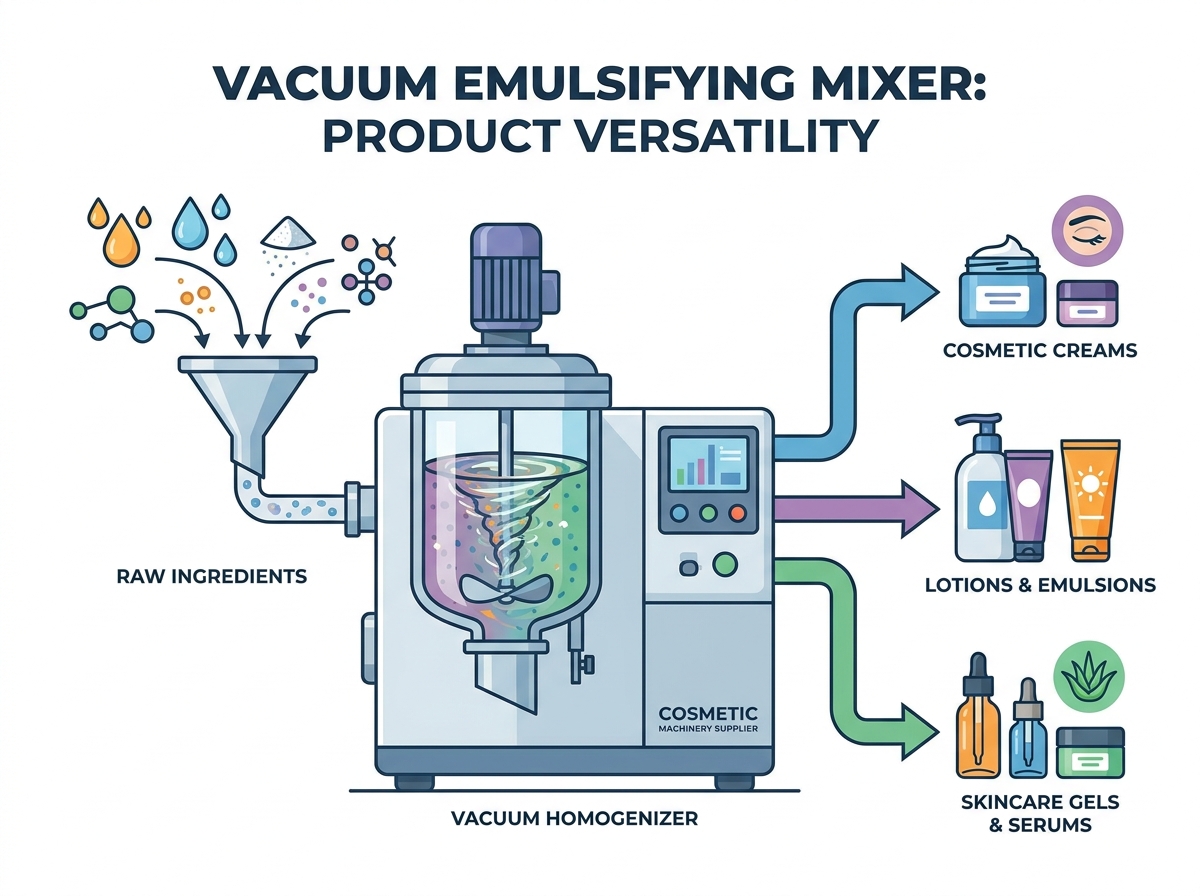
Cosmetic and Personal Care Products
High-Viscosity Creams and Ointments
When functioning as a dedicated cosmetic cream production machine, the equipment must handle extreme rheological challenges. Thick formulations like night creams, barrier creams, and hair waxes suffer from poor heat transfer and tend to adhere to vessel walls. To combat this, the mixer utilizes Teflon wall scrapers that continuously sweep the inner surface of the tank. These scrapers push the cooled or heated material back into the center of the batch, while counter-rotating paddles fold the bulk mass. This dual-action agitation ensures uniform temperature distribution and prevents localized burning or freezing of the high-viscosity matrix. Without these scrapers, a thick layer of product would insulate the jacket, rendering the heating and cooling systems completely ineffective and ruining the batch.
Lotions and Liquid Emulsions
For lighter formulations, the system serves as highly efficient lotion manufacturing equipment. Products such as body milks, cleansing milks, and daily moisturizers require rapid emulsification followed by precise temperature control during the cooling phase. If a lotion is cooled too quickly, the emulsion can break, leading to a watery consistency with floating oil droplets. The jacketed vessel allows for tempered water circulation, gradually bringing the batch down to the required discharge temperature while the homogenizer maintains a stable droplet suspension. Operators often use a step-down cooling method, dropping the jacket temperature in five-degree increments to gently coax the emulsion into its final stable state.
Serums, Gels, and Sunscreens
Advanced skincare products demand rigorous processing parameters. Serums often contain volatile antioxidants, such as Vitamin C or retinol, which degrade rapidly when exposed to oxygen. The vacuum environment protects these sensitive compounds during the high-shear mixing phase. For sunscreens, the challenge lies in the dispersion of difficult mineral powders like zinc oxide or titanium dioxide. The intense shear forces break down powder agglomerates, ensuring an even distribution of UV filters without leaving a gritty texture or causing a white cast on the skin. The vacuum system also prevents the fine mineral powders from becoming airborne dust hazards during the loading phase.
Oral Care (Toothpaste and Gel Dentifrices)
Toothpaste manufacturing presents unique high-viscosity, high-solid processing demands. The formulation requires blending abrasive powders, humectants, and binders into a dense paste. Absolute vacuum de-aeration is critical in this application. If air remains trapped in the paste, it will expand after packaging, causing the toothpaste tubes to swell or burst during transit. The heavy-duty agitation system ensures that the high solid content is thoroughly wetted and dispersed, achieving the exact target density required for automated tube filling lines. The motors driving the agitators in toothpaste mixers are significantly oversized compared to standard cosmetic mixers to handle the immense torque required to move the dense paste.
Color Cosmetics
The production of liquid foundations, concealers, and mascaras relies heavily on uniform pigment dispersion. Color cosmetics contain iron oxides and other colorants that must be ground down and evenly distributed to prevent streaking or color shifting. High-shear homogenization guarantees that pigments are fully developed and consistent across every batch. The vacuum removes air that could otherwise alter the optical properties and specific gravity of the foundation, ensuring perfect color matching and a flawless application texture. Operators frequently pull small samples during the mixing process, drawing them through a vacuum sampling port to check the color match against a master standard before discharging the entire batch.
Pharmaceutical and Medical Applications
Topical Ointments, Creams, and Salves
In pharmaceutical manufacturing, the distribution of active pharmaceutical ingredients (APIs) must meet stringent regulatory standards. Topical ointments and medicated creams require absolute dose uniformity; a patient must receive the exact intended concentration of the API in every application. Vacuum mixing ensures that the active compounds are homogeneously dispersed throughout the excipient base, eliminating hot spots or areas of low concentration that occur with inferior mixing technologies. The validation process for these machines involves extensive testing to prove that the API concentration is identical in samples taken from the top, middle, and bottom of the mixing vessel.
Medicated Gels and Syrups
The processing of sterile or semi-sterile medicated gels and syrups necessitates equipment designed for strict hygiene. These formulations are highly susceptible to microbial contamination. The equipment must feature a sanitary design with no dead legs—areas where product can stagnate and harbor bacteria. Furthermore, the system must support SIP (Sterilize-in-Place) capabilities, allowing high-pressure steam to sanitize the internal components and vessel walls between batches without requiring manual disassembly. The valves used on these vessels are typically sanitary diaphragm valves, which provide a smooth, crevice-free flow path that is easy to clean and sterilize.
Compliance Lens
Equipment utilized for medical applications must adhere to FDA and cGMP (Current Good Manufacturing Practice) guidelines. This requires the use of specific construction materials, primarily 316L stainless steel for all wetted parts, to prevent corrosion and chemical leaching. Internal surfaces must feature electropolished finishes (typically Ra < 0.4 µm) to prevent product adhesion and facilitate thorough cleaning. Additionally, manufacturers must provide traceable material certificates and comprehensive validation documentation to satisfy regulatory audits. Every weld on the interior of the vessel must be ground smooth and polished to ensure there are no microscopic pits where bacteria could hide.
Chemical, Coating, and Food Industry Applications
Chemical Dyeing, Printing Inks, and Coatings
Beyond personal care, high-shear vacuum processing is heavily utilized in the industrial sector for processing dyes, textile printing inks, and specialized paints. These products rely on the precise suspension of fine particles within a liquid carrier. High-shear homogenization prevents pigment agglomeration, ensuring consistent color distribution, optimal opacity, and stable viscosity. The vacuum environment prevents foaming during the rapid incorporation of surfactants and dispersants, which is a common issue in atmospheric ink production. Foaming in ink production can lead to printing defects, as air bubbles in the ink will cause blank spots on the printed substrate.
Specialty Chemicals
The production of adhesives, industrial polishes, automotive waxes, and agricultural chemicals also benefits from this technology. Adhesives require thorough blending of polymers and tackifiers without introducing air that could compromise bond strength. However, manufacturers must account for limitations: highly abrasive materials, such as certain ceramic slurries or heavy industrial compounds, may cause premature wear on standard rotor-stator heads, requiring specialized hardened steel components. Maintenance teams must regularly inspect the rotor-stator gap when processing abrasive chemicals, as wear will increase the clearance and reduce the shear efficiency over time.
Food-Grade Emulsions
In the food industry, manufacturing mayonnaise, dressings, sauces, and flavor emulsions requires stabilizing high-fat and high-water phases. These products are prone to rapid separation if the emulsion is not tightly formed. The high-shear action creates a fine, stable droplet matrix that prevents oil pooling and extends the shelf life of the food product. The vacuum system ensures that the final sauce or dressing has a smooth, creamy mouthfeel, free from the textural inconsistencies caused by trapped air. Food-grade mixers also require specific FDA-approved elastomers for all O-rings and gaskets to ensure no toxic compounds leach into the consumable product.
Evaluating Equipment: Matching the Machine to Your Product Line
Viscosity Capabilities and Agitation Design
Selecting the correct agitation design is entirely dependent on the product's rheology. A single-shaft mixer may suffice for low-viscosity liquids, but complex emulsions require more robust solutions. Dual-shaft designs incorporate a central homogenizer and an outer scraper, suitable for medium viscosities. For ultra-high-viscosity pastes, a triple-shaft design—featuring a homogenizer, a scraper, and an independent counter-rotating paddle—is necessary to ensure the entire mass is continuously forced through the high-shear zone. The counter-rotating paddles create opposing flow patterns that fold the heavy paste over itself, preventing the material from simply spinning in a solid block along with the scraper blades.
Agitation Design | Ideal Viscosity Range (cps) | Typical Product Applications |
|---|---|---|
Single-Shaft Homogenizer | 1 - 10,000 | Serums, Toners, Liquid Dyes, Flavor Emulsions |
Dual-Shaft (Homogenizer + Scraper) | 10,000 - 50,000 | Lotions, Light Creams, Condiments, Shampoos |
Triple-Shaft (Contra-Rotating + Scraper) | 50,000 - 150,000+ | Toothpaste, Heavy Night Creams, Waxes, Ointments |
Heating and Cooling Efficiency
Thermal transfer rates significantly impact overall batch cycle times. Manufacturers must evaluate the trade-offs between electric heating, steam heating, and hot water jackets. Electric heating is self-contained and easier to install but can result in slower heat-up times for large volumes. Steam heating provides rapid, highly efficient thermal transfer, making it ideal for high-throughput facilities, though it requires an external boiler infrastructure. The cooling phase is equally critical; an improperly sized chilled water jacket will bottleneck production by extending the time required to reach safe discharge temperatures. Facilities often install dedicated chiller units specifically for their mixing tanks to ensure a consistent supply of cold water during the summer months when municipal water temperatures rise.
Scalability (From Lab to Skincare Production Line)
Transitioning a formulation from a 10L R&D unit to a 1000L+ production vessel introduces severe risks of non-linear scaling. A common failure occurs when manufacturers assume that simply increasing mixing time will replicate lab results. To achieve successful scalability, the tip speed and shear rates of the rotor-stator must remain constant across different vessel sizes. If the production-scale homogenizer cannot match the shear forces generated in the lab, the resulting emulsion will have larger droplet sizes, leading to instability and phase separation over time. Engineers must calculate the exact peripheral speed of the rotor in the lab unit and ensure the production unit's motor and rotor diameter can match that exact speed.
Implementation Risks and Mitigation Strategies
Over-Shearing and Formula Degradation
Applying too much mechanical energy is a significant operational risk. Over-shearing can break certain polymer chains, destroy the viscosity built by carbomers, or degrade heat-sensitive active ingredients due to localized friction within the rotor-stator gap. To mitigate this risk, facilities must utilize Variable Frequency Drives (VFDs) to precisely control the RPM of the homogenizer and agitators. Furthermore, operators must follow strict Standard Operating Procedures (SOPs) that define exact shear times and speeds for each specific formulation. If a batch is over-sheared, the viscosity will drop permanently, and the product will have to be scrapped or reworked into a lower-grade formulation.
Sizing and Throughput Miscalculations
A frequent pitfall in facility planning is underestimating the total batch turnover time. Calculations often focus solely on the active homogenization phase, ignoring the time required for raw material loading, heating the phases, cooling the finished emulsion, and discharging the viscous product. Miscalculating these auxiliary steps leads to undersized equipment and missed production targets. Accurate throughput modeling must account for the entire end-to-end cycle. For example, discharging a 1000L batch of heavy cream through a standard bottom valve can take over an hour if a positive displacement pump is not utilized to pull the material out of the tank.
Vetting a Cosmetic Machinery Supplier
Partnering with a reliable cosmetic machinery supplier is critical for long-term operational success. Decision-makers should evaluate manufacturers based on their ability to conduct a comprehensive Factory Acceptance Testing (FAT) before shipment. Other critical criteria include the availability of a local spare parts inventory to minimize downtime, robust technical support for PLC/HMI programming and troubleshooting, and the provision of full validation documentation (IQ/OQ/PQ) required for regulatory compliance. A supplier should also be willing to run a pilot test with your specific raw materials to prove their equipment can handle the rheology of your formulations.
Conclusion
Categorize your current and future product portfolio strictly by maximum viscosity, shear sensitivity, and required batch volume before requesting equipment specifications.
Audit your facility's utility infrastructure to determine whether steam, electric, or hot water heating will provide the most efficient thermal transfer for your cycle time goals.
Schedule a pilot test with your actual formulation at the manufacturer's facility to empirically validate droplet size reduction, heating/cooling cycle times, and the effectiveness of the proposed cleaning protocols.
Review the specific geometry of the rotor-stator and scraper blades to ensure they match the rheological demands of your thickest product.
FAQ
Q: What is the difference between a standard mixer and a vacuum emulsifying mixer?
A: A standard mixer operates at atmospheric pressure and folds air into the product, which causes oxidation and instability. A vacuum emulsifying mixer operates under negative pressure to extract air continuously. It features a high-shear rotor-stator workhead designed to break down particle sizes to the micro-level, ensuring long-term emulsion stability.
Q: Can a vacuum homogenizer process dry powders?
A: Yes. Powders are incorporated using inline powder induction systems or by utilizing the vacuum suction to draw powders directly into the fluid stream beneath the liquid level. This method prevents agglomeration, eliminates dusting in the production area, and ensures immediate wetting of the dry ingredients.
Q: What is the maximum viscosity a vacuum emulsifying mixer can handle?
A: High-end models equipped with triple-shaft agitation, heavy-duty motors, and Teflon wall scrapers process highly viscous materials ranging from 100,000 to 150,000 cps. The exact limit depends on the specific geometry of the counter-rotating paddles and the torque capacity of the drive system.
Q: How do you clean a cosmetic cream production machine between batches?
A: Cleaning is managed through automated Clean-in-Place (CIP) systems. High-pressure spray balls are integrated into the vessel lid to flush the interior walls, agitators, and homogenizer with hot water and cleaning detergents. The vessel's self-draining conical bottom ensures that all wash water and residue evacuate completely.
Q: Why is my emulsion breaking after using a vacuum mixer?
A: Emulsion failure is typically caused by formulation or operational errors rather than the machine itself. Common causes include incorrect emulsifier ratios, cooling the batch too rapidly, insufficient shear time, or failing to maintain the correct RPM, which results in droplet sizes that are too large to remain suspended.
Q: What should I look for in a cosmetic machinery supplier?
A: Prioritize suppliers that offer comprehensive aftermarket support, local spare parts availability, and the ability to customize agitator geometries for your specific products. Ensure they provide complete GMP compliance documentation, including material certificates and IQ/OQ/PQ validation protocols required for regulatory audits.


