


Does a Vacuum Emulsifier Work with High-Viscosity Creams?


Scaling the production of high-viscosity products—such as cosmetic creams, heavy ointments, and gel moisturizers—frequently exposes the mechanical limitations of standard mixing equipment, leading to batch inconsistencies and compromised stability. When you move from bench-scale formulation to large-scale manufacturing, the physical properties of these dense materials change drastically. Thick formulations are inherently prone to air entrapment, uneven shear distribution, localized overheating, and phase separation. Traditional open-air mixers fail to overcome the yield stress of these fluids without introducing destructive micro-bubbles or degrading shear-sensitive ingredients. You cannot simply increase the mixing speed and expect a uniform emulsion. Instead, you need a system designed to manipulate flow, shear, and atmospheric pressure simultaneously. A properly configured Vacuum Emulsifier addresses these rheological challenges directly. This guide evaluates the mechanical capabilities, configuration requirements, and implementation realities of using vacuum systems for high-viscosity manufacturing.
Proven Efficacy: Vacuum emulsifiers are highly effective for high-viscosity creams, provided they utilize a combination of high-shear homogenization and multi-directional scraper agitation.
Deaeration is Non-Negotiable: Operating under a vacuum prevents air entrapment during the emulsification process, which is critical for product stability, texture, and preventing oxidation.
Configuration Dictates Success: Success relies on matching the rotor-stator design and motor torque to the specific rheology of the formulation.
Scalability Requires Validation: Moving from R&D to full-scale production requires careful calculation of tip speeds, heat transfer rates, and flow dynamics to prevent cavitation and dead zones.
The Mechanics of High-Viscosity Emulsification
Defining the Success Criteria
A successful high-viscosity emulsion must meet strict physical and chemical parameters. You are looking for uniform droplet size distribution, long-term thermodynamic stability, specific gravity consistency, and a precise rheological profile. If the emulsion breaks, separates, or shifts in viscosity over time, the batch fails. Achieving these metrics requires precise control over mechanical shear forces and fluid dynamics within the mixing vessel. Operators on the floor know that a batch looks entirely different at 60°C compared to its final state at 25°C. You must hit the target viscosity without over-processing the active ingredients.
When evaluating the final product, specific gravity serves as a primary indicator of success. Aerated batches will show a lower specific gravity, leading to under-filled containers on the packaging line. Furthermore, microscopic evaluation should reveal a tight droplet size distribution. Wide variations in droplet size inevitably lead to Ostwald ripening, where smaller droplets merge into larger ones, eventually causing complete phase separation.
Rheological Challenges in Thick Creams and Gels
Cosmetic creams and pharmaceutical ointments typically exhibit non-Newtonian fluid behavior. They possess a yield stress, meaning they behave like a solid until a specific amount of force is applied to make them flow. This creates significant challenges during the mixing phase. Without adequate bulk movement, you risk creating dead zones inside the vessel. In these areas, highly viscous material clings to the walls and avoids the mixing vortex entirely, leading to unmixed raw materials and thermal degradation.
Polymer-based thickeners, such as Carbomer or xanthan gum, introduce another layer of complexity. Dispersing these powders into a liquid phase often results in fish-eyes—undissolved powder agglomerates that ruin the texture of gel moisturizers. Conversely, applying too much mechanical force to break up these agglomerates can cause chain degradation. Over-shearing destroys the polymer network, resulting in a permanent loss of viscosity. You have to balance the shear rate to hydrate the polymer fully without tearing the molecular chains apart.
The Role of the High Shear Homogenizer
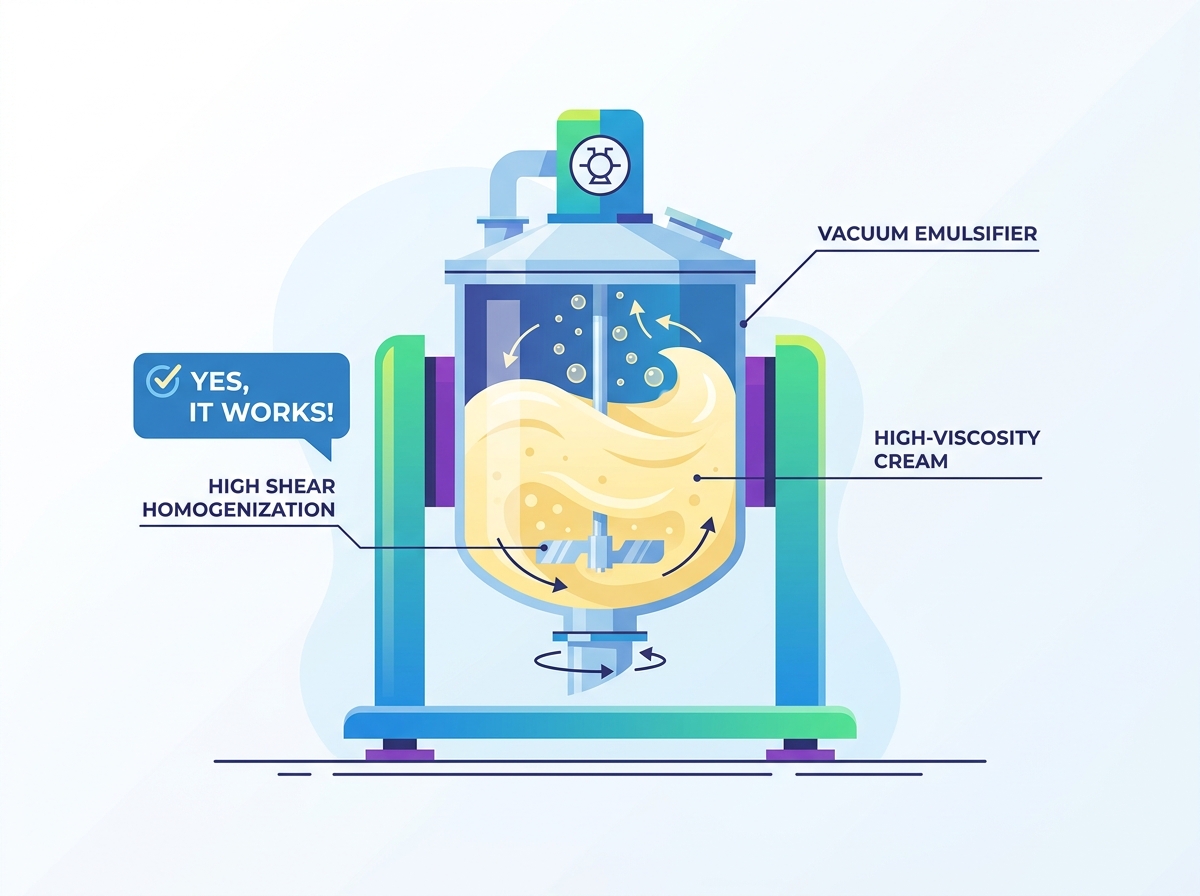
To reduce droplet size effectively, you rely on the rotor-stator dynamics of a high shear homogenizer. The high-speed rotation of the inner rotor draws material into the workhead and expels it through the stationary stator. This process applies intense mechanical shear and hydraulic shear simultaneously. However, high shear alone is insufficient for thick creams. The homogenizer can only process the material that reaches it. If the surrounding fluid is too thick to flow into the workhead, the homogenizer will simply spin in a localized pocket of over-processed material.
This localized spinning generates excessive heat. In a high-viscosity matrix, that heat does not dissipate quickly. It stays trapped in the homogenization zone, potentially burning the product or causing localized phase inversion. Therefore, the homogenizer must work in tandem with a bulk agitation system that constantly feeds fresh material into the high-shear zone while pulling processed material away.
How a Vacuum Emulsifier Overcomes Viscosity Limitations
Multi-Way Agitation and Wall Scrapers
To feed dense materials into the homogenization zone, a cream mixing machine requires multi-way agitation. Coaxial or counter-rotating agitators create complex flow patterns that push and pull the heavy mass throughout the vessel. Teflon (PTFE) wall scrapers play a critical role here. They continuously sweep the inner surface of the vessel, preventing material from baking onto the heated walls. This scraping action folds the outer layers of the batch back into the center, ensuring that all material eventually passes through the high-shear zone.
The design of the scrapers matters immensely. Spring-loaded or hinged scrapers maintain constant contact with the vessel wall, compensating for minor machining tolerances and thermal expansion. If the scrapers lose contact, a boundary layer of product forms on the wall. This layer acts as insulation, destroying the heat transfer efficiency of the jacket and leading to wildly inaccurate temperature readings on your probes.
Vacuum Deaeration in Thick Matrices
Thick matrices trap air easily. When you mix heavy creams, the folding action naturally folds air into the batch. Operating vacuum mixing equipment removes these micro-bubbles before they become permanently suspended in the emulsion. This deaeration process is directly linked to product stability. Removing oxygen prevents the oxidation of sensitive active ingredients like Retinol and Vitamin C. It also reduces the risk of aerobic microbial contamination.
Furthermore, vacuum deaeration ensures packaging accuracy. If a batch contains suspended air, its specific gravity drops. You will end up filling containers with aerated product, which later settles and leaves the jars looking partially empty. Pulling a vacuum guarantees precise volumetric filling and consistent product density. You also eliminate the need for secondary deaeration steps, saving hours of processing time per batch.
Process Condition | Impact on High-Viscosity Emulsions | Resulting Product Quality |
|---|---|---|
Open-Air Mixing | Continuous incorporation of atmospheric air; oxidation of active ingredients. | Spongy texture, poor stability, volume settling post-fill. |
Vacuum Mixing (-0.08 MPa) | Immediate extraction of micro-bubbles; oxygen-deprived environment. | Dense, smooth texture, high stability, accurate volumetric filling. |
Integrated Thermal Management
High-viscosity emulsions often require precise heating to melt waxes and cooling to set the final structure. Integrated heating and cooling jackets allow you to manage these temperature shifts within a single-cycle process. Managing phase inversion temperatures is critical. If the cooling process is uneven due to poor agitation, localized thermal degradation can occur, ruining the batch consistency.
You must control the delta-T (temperature difference) between the jacket and the product. Shock-cooling a heavy cream by flooding the jacket with chilled water can cause the material touching the wall to solidify instantly, breaking the scrapers or stalling the agitator motor. Gradual, controlled cooling, paired with continuous scraping, ensures the entire batch reaches the set point uniformly.
Evaluating Equipment Configurations for High-Viscosity Products
Bottom-Entry vs. Top-Entry Homogenizers
The placement of the homogenizer significantly impacts mixing efficiency for heavy materials. Bottom-entry homogenizers leverage gravity, drawing down heavy materials directly into the high-shear zone. Top-entry systems must pull material upward, which requires more energy and can struggle with extreme viscosities.
Bottom-entry units are generally preferred for high-viscosity applications because they ensure that even the heaviest pastes are forced through the rotor-stator. However, they require robust mechanical seals to prevent leaks at the lowest point of the vessel. Top-entry units eliminate this leak risk but often require a secondary pump to circulate heavy materials effectively.
Specifying Equipment for Varied Formulations
When selecting a high viscosity emulsifier, you must specify adequate motor torque, tight rotor-stator gap tolerances, and a robust vacuum pump capacity. Liquid ring vacuum pumps generally handle moisture better than rotary vane pumps in these applications. Variable Frequency Drives (VFDs) are essential. A VFD allows you to adjust shear and agitation speeds dynamically as a batch transitions from low-viscosity liquid ingredients to a highly viscous finished emulsion.
Calculate the maximum expected viscosity of your toughest formulation at its lowest processing temperature.
Size the agitator motor based on this peak viscosity to prevent stalling.
Select a rotor-stator geometry that balances shear rate with flow capacity.
Ensure the vacuum pump can achieve at least -0.09 MPa to pull air out of dense matrices.
Formulation-Specific Configuration Mapping
High-pigment creams, such as sunscreens containing Zinc Oxide or Titanium Dioxide, require aggressive dispersion to prevent particle agglomeration and ensure an even SPF rating. The homogenizer must break apart these mineral clusters without milling them down to a size where they lose their UV-blocking properties.
Medical ointments demand ointment manufacturing equipment with high-torque extrusion capabilities and highly precise temperature control to maintain active ingredient efficacy. Polymeric gels require low-shear, high-flow stator configurations to preserve the delicate gel network integrity while ensuring uniform hydration.
GMP Compliance and Sanitary Design
In regulated environments, sanitary design is mandatory. Equipment must feature Clean-in-Place (CIP) and Sterilize-in-Place (SIP) capabilities. Surface finishes must meet specific Ra values to prevent bacterial adhesion. Dead-leg-free valve designs ensure that no unmixed or uncleaned material remains trapped in the piping system. Flush-mounted temperature probes and sanitary diaphragm valves are non-negotiable for pharmaceutical applications.
Operational Trade-Offs and Production Efficiency
Capital Expenditure vs. Production Efficiency
Investing in advanced vacuum emulsifying systems directly impacts production efficiency. While these machines require robust infrastructure, they drastically reduce batch cycle times. By combining heating, mixing, homogenization, and cooling into a single vessel under vacuum, you eliminate the need to transfer materials between different tanks. This streamlined process lowers rejection rates and ensures higher throughput.
The reduction in transfer steps also minimizes product loss. When you pump heavy creams from a melting tank to a mixing tank and then to a holding tank, you lose a percentage of the batch in the piping and on the vessel walls. A single-pot vacuum system keeps the entire yield in one place until it is ready for discharge.
Energy Consumption and Motor Sizing
Turning high-viscosity materials demands significant energy. You must balance the trade-off between oversizing and undersizing motors. Oversized motors consume more power and require heavier electrical infrastructure. Undersized motors risk burnout when the emulsion reaches its peak viscosity, leading to incomplete homogenization and ruined batches. Accurate rheological data is required to size the motors correctly for the peak load.
Flexibility vs. Specialization
Facilities often need to produce multiple product types. A machine equipped with interchangeable stators and variable speed drives offers high operational flexibility. It can handle low-viscosity lotions, shampoos, and highly viscous pastes on the same platform. However, highly specialized, continuous-flow homogenizers might offer faster throughput for a single dedicated product line, sacrificing flexibility for raw speed.
Implementation Risks and Mitigation Strategies
Risk: Cavitation in High-Viscosity Fluids
Cavitation occurs when localized pressure drops below the vapor pressure of the liquid, causing bubbles to form and collapse violently. In high-viscosity fluids, this damages the homogenizer and introduces metallic wear particles into the product. You mitigate this by maintaining optimal vacuum pressure control, sizing the impeller correctly, and controlling the feed rate of raw materials to prevent starving the workhead.
Risk: Incomplete Phase Mixing (Stratification)
If the oil and water phases do not mix completely, the batch will stratify and fail. This usually happens when agitation is insufficient to move the entire mass. Mitigate this risk by validating baffle placement and scraper tension during the design phase. Utilizing computational fluid dynamics (CFD) helps visualize flow patterns and identify potential dead zones before the equipment is built.
Risk: Difficult Discharge of Thick Products
Getting a heavy cream out of the mixing vessel can be challenging, leading to product loss and extended cleaning times. To mitigate this, utilize positive displacement discharge pumps like lobe or gear pumps. Applying positive pressure to the vessel during discharge and optimizing the conical bottom design will also force the heavy material out efficiently.
Conclusion
A vacuum emulsifier is the industry-standard requirement for producing stable, air-free, high-quality thick emulsions at scale. Open-air mixing simply cannot handle the rheological demands of modern cosmetic and pharmaceutical formulations. Base equipment selection on the specific rheology of your toughest formulation, the required batch turnover rate, and the stringency of your industry's sanitary standards.
Request pilot-scale testing with your specific raw materials to validate homogenizer performance.
Demand Factory Acceptance Testing (FAT) that proves the equipment can handle your formulation at its maximum viscosity.
Specify Variable Frequency Drives (VFDs) for all agitation and homogenization motors to ensure batch flexibility.
Implement positive displacement pumps for efficient product discharge and reduced waste.
FAQ
Q: What is the maximum viscosity a vacuum emulsifier can handle?
A: Standard vacuum emulsifiers comfortably process materials between 10,000 and 50,000 centipoise (cP). Heavily modified systems with specialized counter-rotating scrapers and high-torque drives handle extreme viscosities upwards of 100,000+ cP, suitable for heavy pastes and medical ointments.
Q: Why is vacuum mixing equipment necessary for cosmetic creams?
A: Operating under a vacuum prevents air entrapment during the high-shear mixing process. Trapped air causes oxidation of active ingredients, promotes bacterial growth, and creates volume discrepancies during packaging. Vacuum deaeration ensures a dense, stable final product.
Q: Can one machine produce both low-viscosity lotions and high-viscosity ointments?
A: Yes. Modern vacuum emulsifiers use variable speed drives and modular agitation systems. By adjusting the RPM of the homogenizer and the sweep speed of the wall scrapers, operators adapt the shear profile for thin lotions or heavy ointments.
Q: How does a high shear homogenizer affect cream texture?
A: The rotor-stator mechanism applies intense mechanical and hydraulic shear, breaking down oil and water droplets to microscopic sizes. A tighter droplet size distribution directly improves the cream's stability, skin-feel, glossiness, and overall spreadability.
Q: How does polymer over-shearing affect gel moisturizer viscosity?
A: Polymeric thickeners rely on long molecular chains to build viscosity. Subjecting them to extreme, prolonged shear physically tears these chains apart. This mechanical destruction leads to a permanent loss of viscosity, resulting in a watery product texture.
Q: What is the typical batch time for high-viscosity emulsions?
A: Batch times vary based on heating and cooling requirements, but a typical cycle in a vacuum emulsifier takes 2 to 4 hours. This is significantly faster than non-vacuum methods, as heating, emulsifying, deaerating, and cooling occur within a single vessel.
Q: How do you clean high-viscosity residue from a vacuum emulsifier?
A: Cleaning relies on integrated Clean-in-Place (CIP) systems. High-pressure spray balls distribute heated solvents and detergents throughout the vessel. A sanitary, crevice-free vessel design with polished surfaces ensures heavy residue washes away without manual scrubbing.


