


How To Choose Vacuum Emulsifier for Cosmetic Creams?


Smooth texture, stable emulsions, and consistent product quality are the priorities for any cosmetic cream manufacturer. Producing these results repeatedly requires precise processing rather than simple mixing. That is why many skincare and personal care manufacturers rely on a Vacuum Emulsifying Mixer when developing creams, lotions, and high-viscosity cosmetic products. Unlike basic mixing equipment, this type of system integrates homogenization, vacuum deaeration, heating, and controlled agitation to ensure uniform emulsification and stable formulations.
Cosmetic creams often contain multiple ingredients such as oils, waxes, emulsifiers, fragrances, and active compounds. Each of these components must be dispersed and emulsified under controlled conditions to produce a smooth and stable final product. Understanding how to choose the right emulsification equipment is therefore a critical step for manufacturers who want to maintain product quality, improve production efficiency, and expand their skincare product lines successfully.
Why Cosmetic Creams Need More Than Basic Mixing
Cream texture depends on emulsification quality, not just blending
A cosmetic cream is a complex emulsion where oil and water phases are combined into a stable structure. Simply stirring ingredients together cannot create the fine particle distribution required for a smooth cream texture. High-shear homogenization is necessary to break down oil droplets into microscopic particles and distribute them evenly throughout the formulation.
Without proper emulsification, creams may separate over time or feel uneven when applied to the skin. A specialized cream emulsifying machine ensures that each batch achieves the same smooth and stable consistency.
Air control matters for appearance, filling, and shelf stability
During traditional mixing processes, air can easily become trapped in the product. These air bubbles may cause several problems during production and packaging. They can affect filling accuracy, create an uneven appearance in jars, and reduce product density.
Vacuum processing technology helps remove these trapped air bubbles during emulsification. This improves product stability and creates a more refined visual appearance.
Temperature and shear can change how a cream feels on skin
Temperature control is essential when working with cosmetic formulations that contain waxes or temperature-sensitive ingredients. Heating allows waxes and oils to melt evenly before emulsification begins, while controlled cooling helps stabilize the final cream structure.
Shear intensity also affects how the cream spreads on the skin. Equipment designed for cosmetic production allows operators to adjust shear levels to achieve the desired sensory properties.
Start with Your Cream Formula, Not the Machine Catalog
Light moisturizing creams and lotions
Light creams and lotions usually have lower viscosity and higher water content. These products still require proper emulsification, but they may not need extremely high homogenization power.
A cosmetic cream mixer designed with adjustable mixing speeds and vacuum capability can easily handle these formulations while maintaining a smooth texture.
Rich creams with waxes, butters, or high oil phase
Products such as body creams, moisturizing balms, and intensive skincare formulas often contain a higher oil phase and thicker ingredients. These formulations require stronger mixing action to achieve a stable emulsion.
Equipment used for these products should have sufficient homogenization capacity and reliable heating functions to ensure the oil phase blends properly with the water phase.
Active ingredient creams that need gentler process control
Certain skincare formulations contain active ingredients that are sensitive to temperature or excessive shear. In these cases, the emulsification process must be carefully controlled to prevent ingredient degradation.
Machines that allow flexible process control help maintain the effectiveness of active compounds while still producing a uniform cream.
The Most Important Machine Features for Cream Production
Homogenizer performance and particle size reduction
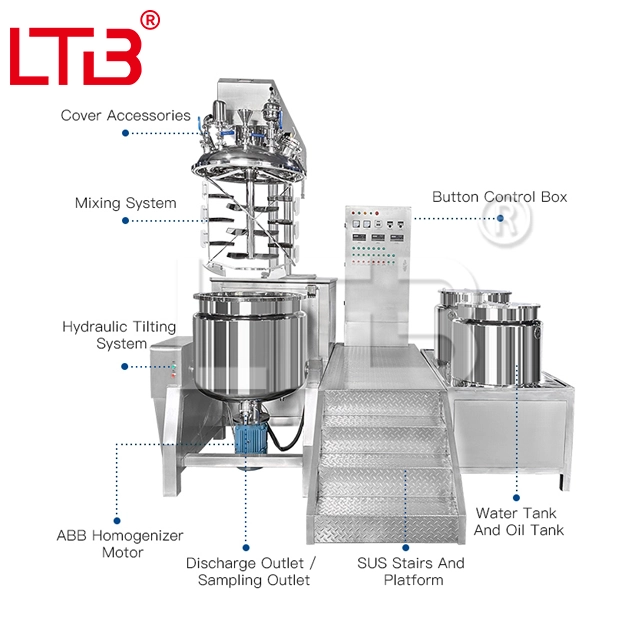
The homogenizer is the central component responsible for emulsification. It uses high shear forces to break down particles and droplets into extremely fine sizes. This process creates a stable and smooth cream structure.
A powerful homogenizer improves product texture and prevents phase separation during storage.
Vacuum function for lower air content and smoother finish
Vacuum systems remove trapped air from the mixture while the product is being processed. This reduces foam formation and improves the final appearance of the cream.
Removing air also enhances filling accuracy during packaging and helps maintain product stability over time.
Heating and cooling for controlled phase handling
Cosmetic cream production often involves heating the oil and water phases separately before emulsification. Integrated heating jackets allow precise temperature control during this stage.
Cooling functions help stabilize the emulsion once the mixing process is complete.
Scraper mixing for wall-to-center circulation
Scraper mixing systems ensure that material attached to the tank walls is continuously moved back into the main mixing zone. This prevents product buildup and ensures uniform mixing throughout the vessel.
This circulation pattern is particularly important when processing thicker cream formulations.
How to Match Capacity to Real Cosmetic Output
Small batches for research and product development
Many cosmetic brands begin production with small batch volumes during the research and development stage. Smaller machines allow formulators to test new recipes without using large quantities of raw materials.
This flexibility supports innovation and experimentation.
Medium production for growing skincare brands
As product demand increases, medium-scale production systems provide the balance between flexibility and efficiency. These systems allow brands to produce consistent batches while maintaining manageable production costs.
Larger batches for stable product lines
Established cosmetic brands that produce high volumes of the same product may benefit from larger batch capacities. Larger equipment allows continuous production and improves efficiency for stable product lines.
What Buyers Often Overlook When Comparing Models
Ease of cleaning between cream formulas
Different cosmetic products often require different formulations. Equipment that is easy to clean allows operators to switch between products quickly without risking contamination.
Smooth internal surfaces and accessible components help simplify cleaning procedures.
Control system and recipe repeatability
Advanced control systems allow operators to store and repeat specific process settings. This ensures that each batch is produced under identical conditions.
Consistent processing helps maintain product quality and reduces production errors.
Material quality and contact-part finish
The quality of stainless steel surfaces used in the equipment affects hygiene and durability. Polished surfaces reduce product adhesion and simplify cleaning.
High-quality construction also improves the lifespan of the equipment.
Serviceability for long production cycles
Machines designed for easy maintenance reduce downtime and support long production runs. Reliable mechanical components help ensure stable performance throughout extended operation.
How to Compare Two Machines Without Getting Lost in Specifications
Ask how the machine handles your specific cream viscosity
Different formulations have different viscosity levels. Equipment that performs well for light lotions may struggle with thick creams.
Understanding the viscosity range the machine can handle is essential.
Ask whether the vacuum system stays stable under load
Vacuum performance can change when the tank is filled with a thick product. Reliable vacuum systems maintain consistent pressure levels even during high-viscosity processing.
Ask which configuration fits future product expansion
Cosmetic companies often expand their product range over time. Choosing flexible equipment allows manufacturers to adapt to new formulations and production requirements.
Why the Right Choice Improves More Than Product Texture
Better batch consistency
Proper emulsification ensures that each batch maintains the same texture, appearance, and stability. This consistency is essential for maintaining consumer trust.
Less rework and lower material waste
When emulsification is stable, fewer batches need to be reprocessed or discarded. This reduces material waste and improves production efficiency.
Easier scale-up from pilot to production
Equipment designed for flexible scaling allows cosmetic brands to move from small experimental batches to full production without major process changes.
What to Check When Choosing a Vacuum Emulsifier for Cosmetic Creams
Selection Factor | Why It Matters for Creams | Questions to Ask | Good Fit For |
Homogenizer power | Ensures stable emulsification | Can it process high viscosity creams | Thick skincare products |
Vacuum capability | Removes trapped air | Does vacuum stay stable during mixing | Premium cosmetic creams |
Heating system | Melts waxes and oils evenly | Is temperature control precise | Oil-rich formulations |
Tank capacity | Matches production scale | What batch size is optimal | Growing cosmetic brands |
Cleaning design | Prevents contamination | Are internal surfaces smooth | Multi-product factories |
Conclusion
Selecting the right emulsification equipment is a strategic decision for cosmetic manufacturers. The ideal system must match the formulation requirements, production capacity, and long-term growth plans of the business. By carefully evaluating homogenization performance, vacuum capability, temperature control, and equipment design, cosmetic brands can ensure that every cream they produce meets high standards of quality and stability. When these factors are considered together, a well-engineered cosmetic cream emulsifying system becomes a valuable asset that supports efficient production and reliable product performance.
Contact Us
If you are planning to improve your cosmetic cream production process or expand your manufacturing capacity, LTB Machinery Co., Ltd. can provide professional equipment solutions designed for cosmetics, pharmaceuticals, food, and personal care industries. Our engineering team can help you identify the right configuration for your production needs and ensure reliable, efficient operation.
Contact us today to learn more about our advanced emulsifying equipment and discover how it can support your cosmetic manufacturing goals.
FAQ
1. Why is a vacuum emulsifying mixer important for cosmetic creams?
Vacuum emulsification removes trapped air and ensures fine particle distribution, creating smoother textures and more stable cosmetic cream formulations.
2. Can one emulsifier machine handle different cosmetic products?
Yes. Many emulsification systems are designed with adjustable mixing speeds and temperature controls, allowing manufacturers to process creams, lotions, gels, and other formulations.
3. How does homogenization improve cream quality?
Homogenization breaks down oil droplets into extremely small particles, creating a uniform emulsion that improves texture, stability, and product appearance.
4. What capacity is suitable for cosmetic cream production?
The best capacity depends on production scale. Small batches are ideal for research and development, while larger systems are better for stable high-volume production lines.


